 ChipApex | Global Electronic Components Supplier
SEARCH
Search Product
Search Post
— IC芯片 | 连接器 | 传感器 | 被动器件 —
Search productSearch post
— IC芯片 | 连接器 | 传感器 | 被动器件 —
Consult the customer manager about the wholesale price.
consultation hotline:86-132-6715-2157
email:[email protected]
Contact the product manager for consultation. One-stop consultation is available.
Do you want a lower wholesale price? Please send us your inquiry and we will reply immediately.
The AD5665RBRUZ-2 is a quad, 16-bit buffered voltage-output digital-to-analog converter (DAC) from the nanoDAC family. It features an on-chip 2.5 V reference with a temperature coefficient of 5 ppm/°C, enabling a full-scale output range of 5 V. The device operates on a single 2.7 V to 5.5 V supply and supports I2C-compatible serial interfaces in standard (100 kHz), fast (400 kHz), and high-speed (3.4 MHz) modes. Key specifications include ±8 LSB relative accuracy, ±1 LSB differential nonlinearity, and a settling time of 4 µs to ±2 LSB. It incorporates hardware LDAC and CLR functions, per-channel power-down, and a power-on reset circuit.
Verify the specific suffix -2 against the manufacturer's ordering guide to confirm pinout and feature configuration. Ensure the design supports the required I2C bus capacitance for high-speed mode operation up to 3.4 MHz. Confirm that the 14-lead TSSOP package thermal impedance meets the system's power dissipation requirements under maximum operating conditions.
Select this component when a quad channel DAC with integrated high-precision reference is required. The AD5665RBRUZ-2 is suitable for applications needing 16-bit accuracy and low drift. Compare with the AD5665RBCPZ variant if a smaller LFCSP package is preferred, noting the difference in reference temperature coefficient and pin count. Ensure the external pull-up resistors on SDA and SCL are sized correctly for the chosen I2C speed.
This part belongs to the AD5625R/AD5645R/AD5665R series of nanoDACs. It shares the same functional block diagram and interface protocol as the 12-bit AD5625R and 14-bit AD5645R. The 'R' suffix indicates the presence of an on-chip reference, while the 'BRUZ' designation specifies the 14-lead TSSOP package and industrial temperature range (-40°C to +105°C).
The AD5665RBRUZ-2REEL7 is a reel-packaged version of the same device. For SPI interface alternatives within the same family, consider the AD5664R series. Direct pin-for-pin replacements with different resolutions or reference types require verification of electrical parameters and software compatibility.
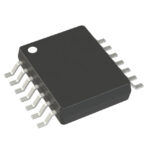 AD5665RBRUZ-2
The activity of extra discounts on wholesale prices is in full swing…
Please fill in your contact information and we will send you the latest wholesale price list.





