ChipApex | Global Electronic Components Supplier
SEARCH
Search Product
Search Post
— IC芯片 | 连接器 | 传感器 | 被动器件 —
Search productSearch post
— IC芯片 | 连接器 | 传感器 | 被动器件 —
Consult the customer manager about the wholesale price.
consultation hotline:86-132-6715-2157
email:[email protected]
Contact the product manager for consultation. One-stop consultation is available.
Do you want a lower wholesale price? Please send us your inquiry and we will reply immediately.
The AD5683RBRMZ is a single-channel, 16-bit buffered voltage output digital-to-analog converter (DAC) from the nanoDAC+ family. It features an integrated 2.5 V reference with a typical drift of 2 ppm/°C and ±2 LSB maximum integral nonlinearity (INL). The device operates on a single 2.7 V to 5.5 V analog supply and supports independent logic voltages from 1.62 V to 5.5 V. It utilizes a versatile 3-wire SPI interface with clock rates up to 50 MHz. Key specifications include a settling time of 5 µs, low glitch impulse of 0.1 nV-sec, and high drive capability of 20 mA. The component is housed in a 10-lead MSOP package.
Verify the specific grade (A or B) required for INL performance, as specifications vary between ±8 LSB and ±2 LSB. Confirm pin compatibility regarding the availability of optional pins such as RESET, LDAC, VLOGIC, and SDO, which are not present on all model variants within the same package type. Ensure the ordering suffix matches the desired configuration and packaging format.
Select this component when a single-channel, high-precision 16-bit DAC is required in a small footprint. The internal reference eliminates the need for external components if a 2.5 V reference is acceptable. Verify that the application requires a buffered voltage output capable of driving loads up to 20 mA. Consider the independent logic supply range if interfacing with lower voltage digital controllers.
This part belongs to the AD5683R series, which includes 16-bit, 14-bit, and 12-bit variants. The 'R' suffix indicates the inclusion of an internal reference, distinguishing it from the AD5683 which requires an external reference. The 'B' in the middle typically denotes the B-grade accuracy level. Other packages available for this family include an 8-lead LFCSP.
The AD5683 (without R) is a compatible alternative if an external reference is used. The AD5682R and AD5681R offer 14-bit and 12-bit resolutions respectively, maintaining pin compatibility. For I2C interface requirements, the AD5693R serves as a functional equivalent.
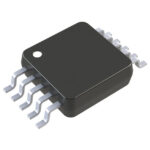 AD5683RBRMZ
The activity of extra discounts on wholesale prices is in full swing…
Please fill in your contact information and we will send you the latest wholesale price list.