 ChipApex | Global Electronic Components Supplier
SEARCH
Search Product
Search Post
— IC芯片 | 连接器 | 传感器 | 被动器件 —
Search productSearch post
— IC芯片 | 连接器 | 传感器 | 被动器件 —
Consult the customer manager about the wholesale price.
consultation hotline:86-132-6715-2157
email:[email protected]
Contact the product manager for consultation. One-stop consultation is available.
Do you want a lower wholesale price? Please send us your inquiry and we will reply immediately.
The AD5694BRUZ-RL7 is a quad, 12-bit buffered voltage output Digital-to-Analog Converter (DAC) from the nanoDAC+ family by Analog Devices. It features an I2C-compatible serial interface and operates on a single 2.7 V to 5.5 V supply. The device includes a user-selectable gain pin for full-scale outputs of 2.5 V or 5 V. Key specifications include a maximum Integral Nonlinearity (INL) of ±1 LSB, offset error of ±1.5 mV, and gain error of ±0.1% FSR. It supports 400 kHz clock rates, offers per-channel power-down modes reducing current to 4 µA, and utilizes a TSSOP-16 package.
Verify the specific grade (A or B) required for your application, as performance parameters like INL vary between grades. Confirm the package type matches the design; the suffix RUZ indicates a TSSOP-16 package, while LFCSP variants exist. Ensure the logic voltage (VLOGIC) range of 1.62 V to 5.5 V is compatible with the host microcontroller. Check for availability constraints as distribution status may vary.
Select the AD5694BRUZ-RL7 when four independent 12-bit channels are needed with I2C connectivity. Choose this part over the AD5696 if 12-bit resolution is sufficient, as it offers lower cost and potentially lower power. Consider the gain setting: use Gain = 1 for 0–VREF output or Gain = 2 for 0–2×VREF. Ensure the external reference voltage does not exceed the supply voltage limits defined in the specifications table.
This component belongs to the AD5696/AD5694 nanoDAC+ family, which shares functional similarities but differs in resolution and interface. The AD5694 is the 12-bit counterpart to the 16-bit AD5696. Both support I2C and feature similar power management and reset functionalities. The 'RL7' suffix typically denotes a reel packaging format, distinct from tube packaging options available for other variants in the series.
The AD5696RBRUZ-RL7 is a direct pin-compatible alternative offering 16-bit resolution instead of 12-bit. Other family members like the AD5684RBRUZ provide SPI interfaces rather than I2C, requiring software changes. Verify that any replacement maintains the same package footprint (TSSOP-16) and electrical characteristics such as supply voltage and current consumption.
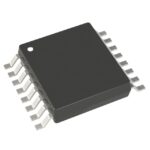 AD5694BRUZ-RL7
The activity of extra discounts on wholesale prices is in full swing…
Please fill in your contact information and we will send you the latest wholesale price list.





