 ChipApex | Global Electronic Components Supplier

SEARCH
Search Product
Search Post
— IC芯片 | 连接器 | 传感器 | 被动器件 —
Search productSearch post
— IC芯片 | 连接器 | 传感器 | 被动器件 —
Consult the customer manager about the wholesale price.
consultation hotline:86-132-6715-2157
email:[email protected]
Contact the product manager for consultation. One-stop consultation is available.
Do you want a lower wholesale price? Please send us your inquiry and we will reply immediately.
The AD660BN is a monolithic 16-bit serial/byte DACPORT manufactured by Analog Devices Inc. It integrates an on-chip buried Zener voltage reference, double-buffered latches, and an output amplifier. The device operates within a temperature range of −40°C to +85°C and utilizes a BiMOS II process. Key electrical specifications include ±1 LSB integral nonlinearity (INL) and differential nonlinearity (DNL), 15-bit monotonicity over temperature, and a typical glitch impulse of 15 nV-s. The internal reference is laser-trimmed to 10.000 V with a drift of ±15 ppm/°C. Output ranges are pin-programmable for unipolar (0 V to 10 V) or bipolar (−10 V to +10 V) configurations.
Verify the specific grade suffix BN against the ordering guide to confirm the plastic DIP package and temperature range. Ensure supply voltages match the specified limits: +VCC between +13.5 V and +16.5 V, −VEE between −13.5 V and −16.5 V, and +VLL at 5 V. Confirm that the application environment remains within the −40°C to +85°C operating range defined for this grade.
Select the AD660BN when 15-bit monotonicity and ±1 LSB INL/DNL are required without external trimming. Choose this component if a single-supply digital interface (5 V) is needed alongside dual analog supplies. Consider the internal 10 V reference for cost-sensitive designs; however, for lower drift requirements, an external precision reference such as the AD587 or AD688 should be used instead of the internal source.
The AD660 belongs to the DACPORT family, which combines high-precision bipolar linear circuitry with low-power CMOS logic on a single chip. The BN grade specifically denotes the commercial temperature range variant packaged in a 24-lead 300 mil plastic DIP. Other grades include AN (plastic DIP), AR/BR (SOIC), and SQ (CERDIP/Military).
Publicly confirmed substitute part numbers for the AD660BN are not available in the provided documentation. Designers should evaluate modern replacements based on resolution, interface compatibility, and package dimensions, noting that direct pin-for-pin substitutes may require schematic adjustments due to architectural differences.
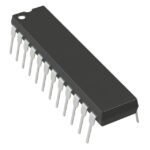 AD660BN

The activity of extra discounts on wholesale prices is in full swing…
Please fill in your contact information and we will send you the latest wholesale price list.






