 ChipApex | Global Electronic Components Supplier

SEARCH
Search Product
Search Post
— IC芯片 | 连接器 | 传感器 | 被动器件 —
Search productSearch post
— IC芯片 | 连接器 | 传感器 | 被动器件 —
Consult the customer manager about the wholesale price.
consultation hotline:86-132-6715-2157
email:[email protected]
Contact the product manager for consultation. One-stop consultation is available.
Do you want a lower wholesale price? Please send us your inquiry and we will reply immediately.
The AD660BR is a monolithic 16-bit digital-to-analog converter (DAC) from the DACPORT series, manufactured by Analog Devices Inc. It integrates an on-chip buried Zener voltage reference, double-buffered latches, and an output amplifier on a single BiMOS II die. The device supports serial or byte input interfaces and features a fast 40 ns write pulse with an asynchronous clear function to 0 V. Key electrical specifications include ±1 LSB integral linearity, 15-bit monotonicity over temperature, low glitch energy of 15 nV-s, and total harmonic distortion plus noise (THD+N) of 0.009%. It operates with unipolar or bipolar outputs and includes a serial output pin for daisy-chaining capabilities.
Verify component status as the AD660BR may be discontinued or subject to limited availability. Confirm package type (24-SOIC) and revision level against current datasheets. Check for lead time constraints if sourcing through distributors. Ensure compatibility with existing system power supplies and logic levels before procurement.
Select the AD660BR when 16-bit resolution and high linearity are required in a serial/byte interface format. Consider the integrated reference and amplifier for simplified design compared to discrete solutions. Evaluate power supply requirements (±13.5V to 16.5V analog, 5V digital) and operating temperature range (-40°C to 85°C). Compare glitch performance and settling time against alternative DACs if dynamic response is critical.
The AD660BR belongs to the DACPORT family, which combines high-precision bipolar linear circuitry with CMOS logic on a BiMOS II process. This integration allows for compact, low-power designs without sacrificing accuracy. The BR suffix typically denotes a specific package variant (24-SOIC) and temperature range within the broader AD660 product line.
Direct replacements should maintain 16-bit resolution, serial/byte interface, and similar pinout. Verify if newer revisions or RoHS-compliant versions (e.g., AD660BRZ) are available. Cross-reference with other DACPORT models like AD669 for functional similarities, but confirm interface and performance differences.
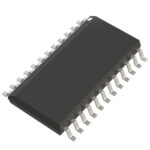 AD660BR

The activity of extra discounts on wholesale prices is in full swing…
Please fill in your contact information and we will send you the latest wholesale price list.





