 ChipApex | Global Electronic Components Supplier
SEARCH
Search Product
Search Post
— IC芯片 | 连接器 | 传感器 | 被动器件 —
Search productSearch post
— IC芯片 | 连接器 | 传感器 | 被动器件 —
Consult the customer manager about the wholesale price.
consultation hotline:86-132-6715-2157
email:[email protected]
Contact the product manager for consultation. One-stop consultation is available.
Do you want a lower wholesale price? Please send us your inquiry and we will reply immediately.
The AD7195BCPZ-RL is a low-noise, complete analog front end for high precision measurement applications. It contains a low noise, 24-bit sigma-delta (Σ-Δ) analog-to-digital converter (ADC). The on-chip low noise gain stage means that signals of small amplitude can be interfaced directly to the ADC. The AD7195 contains ac excitation, which is used to remove dc-induced offsets from bridge sensors. The device can be configured to have two differential inputs or four pseudo differential inputs. The on-chip channel sequencer allows several channels to be enabled, and the AD7195 sequentially converts on each enabled channel. This simplifies communication with the part. The on-chip 4.92 MHz clock can be used as the clock source to the ADC or, alternatively, an external clock or crystal can be used. The output data rate from the part can be varied from 4.7 Hz to 4.8 kHz.
Verify the ordering suffix -RL indicates reel packaging when sourcing components. Confirm the specific B version temperature range (-40°C to +105°C) matches application requirements. Ensure AVDD is supplied between 4.75 V and 5.25 V, while DVDD operates from 2.7 V to 5.25 V. Check for moisture sensitivity levels if storage conditions exceed specified limits.
Select the AD7195BCPZ-RL for applications requiring ultralow noise and high resolution in a compact LFCSP package. Consider the internal AC excitation feature for eliminating DC offsets in bridge sensors. Evaluate the programmable gain amplifier settings ranging from 1 to 128 to match input signal amplitudes. Verify compatibility with SPI, QSPI, MICROWIRE, and DSP interfaces for system integration.
The AD7195BCPZ-RL belongs to the AD7195 family of ultralow noise, 24-bit Sigma-Delta ADCs. It is designed for high precision measurement applications where low noise and high accuracy are critical. The component integrates a PGA and AC excitation, reducing the need for external components. It is commonly used in industrial instrumentation and scientific equipment.
The AD7190 and AD7192 are pin-compatible alternatives within the same family. The AD7190 lacks AC excitation, while the AD7192 offers different filter options. Verify functional differences before substitution to ensure compatibility with existing designs.
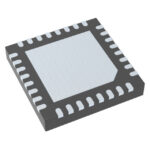 AD7195BCPZ-RL
The activity of extra discounts on wholesale prices is in full swing…
Please fill in your contact information and we will send you the latest wholesale price list.





