 ChipApex | Global Electronic Components Supplier

SEARCH
Search Product
Search Post
— IC芯片 | 连接器 | 传感器 | 被动器件 —
Search productSearch post
— IC芯片 | 连接器 | 传感器 | 被动器件 —
Consult the customer manager about the wholesale price.
consultation hotline:86-132-6715-2157
email:[email protected]
Contact the product manager for consultation. One-stop consultation is available.
Do you want a lower wholesale price? Please send us your inquiry and we will reply immediately.
The AD7228ABNZ is an LC2MOS octal 8-bit digital-to-analog converter (DAC) featuring integrated output buffer amplifiers. It operates with single or dual supplies, supporting VDD ranges of 10.8 V to 16.5 V and VSS of −5 V ± 10%. The device provides eight independent voltage-mode outputs with a settling time of 5 µs to ±1/2 LSB. Static performance includes differential nonlinearity of ±1 LSB and total unadjusted error of ±2 LSB for the B version. Digital inputs are TTL/CMOS compatible, and the interface logic supports microprocessor speeds with a 95 ns write pulse width.
Verify the specific grade suffix 'B' against the ordering guide to confirm static performance tolerances such as total unadjusted error and relative accuracy. Ensure the package type matches the required pinout, as the ABNZ designation corresponds to the 24-lead PDIP variant. Confirm that the application environment stays within the specified operating temperature range of −40°C to +85°C for guaranteed specifications.
Select this component when eight independent 8-bit channels are required without external buffering. The AD7228 allows single-supply operation if a 10 V reference is available, though dual supplies enhance negative-going settling time near 0 V. Consider the 2 kΩ minimum load resistance requirement for the output buffers. Verify that the system can provide the necessary reference current, as input impedance varies with code.
The AD7228 belongs to the Analog Devices LC2MOS family of monolithic DACs. It integrates high-speed digital logic and precision analog circuits using ion-implanted CMOS technology. The device eliminates the need for external trims and offers a compact solution compared to discrete implementations. The ABNZ variant specifically denotes the commercial grade B version in a 24-lead plastic dual in-line package.
Direct pin-compatible replacements within the same package may include other grades of the AD7228 series, such as the AD7228AKNZ (Grade A) for tighter error specifications. Cross-family replacements require careful evaluation of interface logic compatibility and output drive capabilities.
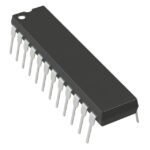 AD7228ABNZ

The activity of extra discounts on wholesale prices is in full swing…
Please fill in your contact information and we will send you the latest wholesale price list.





