 ChipApex | Global Electronic Components Supplier

SEARCH
Search Product
Search Post
— IC芯片 | 连接器 | 传感器 | 被动器件 —
Search productSearch post
— IC芯片 | 连接器 | 传感器 | 被动器件 —
Consult the customer manager about the wholesale price.
consultation hotline:86-132-6715-2157
email:[email protected]
Contact the product manager for consultation. One-stop consultation is available.
Do you want a lower wholesale price? Please send us your inquiry and we will reply immediately.
The AD7233ANZ is a complete 12-bit voltage-output digital-to-analog converter (DAC) fabricated on LC2MOS technology. It integrates an output amplifier and a Zener voltage reference within an 8-lead Mini-DIP package, eliminating the need for external trims. The device supports a bipolar output range of –5 V to +5 V using two’s complement data format. It features a versatile 3-wire serial interface compatible with microcomputers and DSPs, allowing clock rates up to 5 MHz for a DAC update rate of 300 kHz. Power supplies range from 10.8 V to 16.5 V for both VDD and VSS.
Verify the specific version suffix against the datasheet ordering guide. The 'N' in AD7233ANZ denotes the Plastic DIP (N-8) package option. Confirm that the A Version specifications, such as ±1 LSB relative accuracy, meet the design requirements compared to the B Version's ±1/2 LSB accuracy. Ensure power supply decoupling capacitors are included in the design for optimal performance.
Select the AD7233ANZ for applications requiring a single-chip solution with integrated reference and buffer. The A Version offers ±1 LSB accuracy, while the B Version provides ±1/2 LSB. The device requires dual supplies between ±10.8 V and ±16.5 V. For unipolar output ranges or single-supply operation, consider the AD7243 instead. The serial interface simplifies connections to standard microcontrollers and DSP processors.
The AD7233 belongs to Analog Devices' DACPORT family, designed for space-saving and reliability through monolithic integration. The ANZ suffix indicates the industrial temperature range (-40°C to +85°C) and the N-8 plastic DIP package. This component serves as a compact alternative to multi-chip DAC designs, reducing board space and assembly complexity for 12-bit conversion tasks.
For unipolar or single-supply requirements, the AD7243 is the designated alternative. For higher accuracy needs within the same package, the AD7233BNZ (B Version) provides ±1/2 LSB relative accuracy. No direct pin-compatible substitutes with different architectures are listed in the provided documentation.
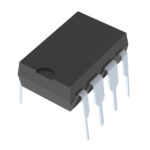 AD7233ANZ

The activity of extra discounts on wholesale prices is in full swing…
Please fill in your contact information and we will send you the latest wholesale price list.





