 ChipApex | Global Electronic Components Supplier

SEARCH
Search Product
Search Post
— IC芯片 | 连接器 | 传感器 | 被动器件 —
Search productSearch post
— IC芯片 | 连接器 | 传感器 | 被动器件 —
Consult the customer manager about the wholesale price.
consultation hotline:86-132-6715-2157
email:[email protected]
Contact the product manager for consultation. One-stop consultation is available.
Do you want a lower wholesale price? Please send us your inquiry and we will reply immediately.
The AD7303BRM is a dual, 8-bit voltage output digital-to-analog converter (DAC) from Analog Devices. It operates on a single +2.7 V to +5.5 V supply and features rail-to-rail output buffers with a typical settling time of 1.2 μs. The device integrates a 16-bit serial shift register compatible with SPI, QSPI, and Microwire interfaces, supporting clock rates up to 30 MHz. It includes an internal reference derived from VDD/2 or accepts external references between 1 V and VDD/2. Power consumption is typically 2.3 mA at 3.3 V, reducing to less than 1 μA in full power-down mode. The component is housed in an 8-lead microSOIC package.
Verify the specific suffix 'RM' corresponds to the 8-lead microSOIC package when sourcing. Confirm the 'B' grade designation indicates the -40°C to +105°C operating temperature range required for the application. Ensure compatibility with the host processor's serial interface timing requirements, particularly regarding the 30 MHz maximum SCLK rate.
Select this component for applications requiring two independent 8-bit outputs in a compact surface-mount package. The internal reference simplifies design by eliminating external precision reference components, though external references are supported for higher accuracy needs. Consider the 1 LSB DNL specification for monotonicity requirements. The low power-down current makes it suitable for energy-constrained portable systems.
The AD7303 belongs to Analog Devices' family of low-power, single-supply DACs. The BRM variant specifically denotes the industrial temperature range (-40°C to +105°C) and the microSOIC (RM-8) package option. It serves as a cost-effective solution for multi-channel signal generation where moderate resolution and high speed are balanced with low power consumption.
The AD7304 is a quad-channel version of this device offering four DACs in a larger package. For single-channel applications, the AD7301 provides a similar feature set in an 8-pin package. Verify pinout compatibility if substituting with other dual-DAC parts, as interface protocols and control bit definitions may differ.
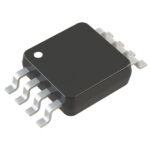 AD7303BRM

The activity of extra discounts on wholesale prices is in full swing…
Please fill in your contact information and we will send you the latest wholesale price list.






