 ChipApex | Global Electronic Components Supplier

SEARCH
Search Product
Search Post
— IC芯片 | 连接器 | 传感器 | 被动器件 —
Search productSearch post
— IC芯片 | 连接器 | 传感器 | 被动器件 —
Consult the customer manager about the wholesale price.
consultation hotline:86-132-6715-2157
email:[email protected]
Contact the product manager for consultation. One-stop consultation is available.
Do you want a lower wholesale price? Please send us your inquiry and we will reply immediately.
The AD737AQ is a low power, precision, monolithic true RMS-to-DC converter manufactured by Analog Devices. It computes the true root-mean-square value of an input signal and provides a corresponding DC output voltage. The device features a wide power supply range from ±2.5 V to ±16.5 V and maintains high accuracy with a maximum error of ±0.2 mV plus 0.3% of reading for sine wave inputs. It supports signals with crest factors up to 5 and offers a 200 mV full-scale input range. The component operates within a temperature range of -40 °C to +85 °C and utilizes a 14-pin CDIP package.
Verify the specific suffix 'AQ' corresponds to the commercial temperature grade (-40 °C to +85 °C) and ceramic dual in-line package (CDIP). Confirm that the datasheet revision matches the required electrical tolerances, specifically the ±0.2 mV offset and 0.3% gain accuracy specifications. Ensure the ordering information aligns with the 14-pin configuration and single-chip architecture defined in the official Analog Devices documentation.
Select this component when precise RMS conversion is required for complex waveforms including pulses and phase-controlled signals. It is suitable for applications demanding high input impedance and low power consumption. Consider the negative-going output characteristic and verify compatibility with downstream circuitry. The device eliminates the need for external calibration trims, simplifying design compared to discrete solutions.
The AD737 series represents a family of precision analog computing devices designed for accurate signal measurement. As a monolithic solution, it integrates the necessary circuitry for RMS computation on a single chip. This approach reduces physical size and cost while improving reliability over traditional discrete implementations. The AQ variant specifies the industrial temperature range and packaging style for robust operation.
The AD736 serves as a functional alternative with a positive-going output characteristic. Both devices share the same basic internal architecture and performance metrics. Selection between them depends primarily on the polarity requirements of the subsequent stage in the signal chain.
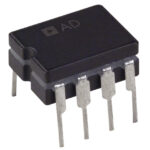 AD737AQ

The activity of extra discounts on wholesale prices is in full swing…
Please fill in your contact information and we will send you the latest wholesale price list.





