 ChipApex | Global Electronic Components Supplier

SEARCH
Search Product
Search Post
— IC芯片 | 连接器 | 传感器 | 被动器件 —
Search productSearch post
— IC芯片 | 连接器 | 传感器 | 被动器件 —
Consult the customer manager about the wholesale price.
consultation hotline:86-132-6715-2157
email:[email protected]
Contact the product manager for consultation. One-stop consultation is available.
Do you want a lower wholesale price? Please send us your inquiry and we will reply immediately.
AD7720BRUZ-REEL is listed in the ADCs/DACs - Special Purpose range at ChipApex. The manufacturer field lists Analog Devices Inc.. Its product description is IC SIGMA-DELTA 16B 12.5M 28TSSOP. Review the specifications below when checking this part for your BOM.
The AD7720BRUZ is a 7th-order CMOS sigma-delta modulator in a 28-lead TSSOP package. It converts analog signals into a high-speed 1-bit data stream using a differential input range of 0 V to +2.5 V or ±1.25 V. Operating from a single +5 V supply, the device features an on-chip 2.5 V reference and supports master clock frequencies up to 12.5 MHz. Key static performance metrics include 16-bit resolution, ±1 LSB maximum differential nonlinearity, and ±2 LSB typical integral nonlinearity.
Verify the REEL suffix indicates tape-and-reel packaging rather than tube packaging. Confirm the B version temperature range (-40°C to +85°C) matches system requirements. Ensure the 28-lead TSSOP footprint aligns with PCB layout specifications before ordering.
Select this component when a high-speed bit-stream output is required for external digital filtering. The internal oscillator requires an external crystal or CMOS clock source. Designers must account for the switched-capacitor input impedance, which varies with the master clock frequency, when selecting driving amplifiers.
The AD7720 belongs to Analog Devices' family of sigma-delta modulators. It serves as the front-end converter for systems utilizing external decimation filters, such as those found in the AD7722. The BRUZ designation specifies the industrial temperature grade and surface-mount TSSOP-28 package configuration.
The AD7722 is a pin-compatible integrated solution that includes the digital filter. Verify interface compatibility if substituting with other sigma-delta modulators, as clocking and reset timing may differ.
In bipolar mode, the inputs are centered about a common-mode bias, typically 1.25 V. In unipolar mode, the range is 0 V to VREF.
MZERO grounds the modulator inputs to measure offset error, while GC enables gain error calibration.
No, it requires a master clock via XTAL1/MCLK, generated by an external crystal or CMOS signal.
Explore related parts through Data Acquisition, Integrated Circuits (ICs), all product categories, ChipApex homepage.
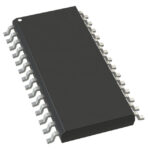 AD7720BRUZ-REEL

The activity of extra discounts on wholesale prices is in full swing…
Please fill in your contact information and we will send you the latest wholesale price list.





