 ChipApex | Global Electronic Components Supplier
AD7721ANZ
Search Product
Search Post
— IC芯片 | 连接器 | 传感器 | 被动器件 —
Search productSearch post
— IC芯片 | 连接器 | 传感器 | 被动器件 —
Consult the customer manager about the wholesale price.
consultation hotline:86-132-6715-2157
email:[email protected]
Contact the product manager for consultation. One-stop consultation is available.
Do you want a lower wholesale price? Please send us your inquiry and we will reply immediately.
The AD7721ANZ is a complete low-power, 16-bit sigma-delta analog-to-digital converter manufactured by Analog Devices Inc. It operates from a single +5 V supply and accepts differential inputs of 0 V to 2.5 V or ±1.25 V. The device features an internal analog modulator that continuously samples the input at twice the clock frequency, eliminating the need for external sample-and-hold circuits. It supports both high-speed serial and parallel interfaces, with maximum clock frequencies of 15 MHz and 10 MHz respectively. The part includes on-chip offset and gain calibration, two cascaded FIR digital filters, and a standby mode reducing power consumption to 100 μW.
Verify the specific revision level and package option when sourcing components. Confirm that the operating temperature range aligns with industrial specifications. Ensure proper ESD handling procedures are followed during assembly due to the sensitivity of the CMOS construction. Cross-reference pin configurations against the latest datasheet revisions to avoid integration errors.
Select this component for applications demanding high sampling rates up to 468.75 kHz with 16-bit resolution. Consider the serial interface for simplified wiring or parallel mode for higher throughput requirements. Evaluate the external clock frequency constraints, as performance metrics scale proportionally with the master clock input. Verify that the input voltage ranges match the sensor output specifications before finalizing the design.
The AD7721 belongs to the AD7721 series of sigma-delta ADCs from Analog Devices. It is distinct from lower-speed variants like the AD7712 or AD7713, which prioritize precision over bandwidth. The 'AN' suffix indicates a plastic DIP package with an industrial temperature range. This model serves as a bridge between high-resolution slow converters and high-speed flash architectures.
Direct replacements include the AD7721AR for SOIC packaging or the AD7721SQ for extended temperature ranges. For system upgrades, consider the AD7722 or AD7723 if additional channels or different interface options are required. Ensure pin compatibility and software register mappings remain consistent when substituting within the same family.
No, the analog input is continuously sampled by the internal analog modulator at twice the clock frequency, eliminating the need for external sample-and-hold circuitry.
The input bandwidth, sample rate, filter corner frequency, and output word rate are all proportional to the external clock frequency. For example, a 15 MHz clock yields a 229.2 kHz input bandwidth.
The DVAL pin indicates when an overrange input signal has resulted in invalid data. It goes low if small overloads clip the output or if large overloads cause modulator instability.
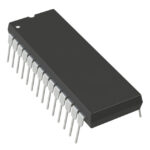 AD7721ANZ
The activity of extra discounts on wholesale prices is in full swing…
Please fill in your contact information and we will send you the latest wholesale price list.