 ChipApex | Global Electronic Components Supplier
SEARCH
Search Product
Search Post
— IC芯片 | 连接器 | 传感器 | 被动器件 —
Search productSearch post
— IC芯片 | 连接器 | 传感器 | 被动器件 —
Consult the customer manager about the wholesale price.
consultation hotline:86-132-6715-2157
email:[email protected]
Contact the product manager for consultation. One-stop consultation is available.
Do you want a lower wholesale price? Please send us your inquiry and we will reply immediately.
The AD7730BR is a complete analog front end for weigh-scale and pressure measurement applications, featuring a Sigma-Delta architecture. It provides 24-bit resolution with no missing codes and achieves 230,000 counts peak-to-peak. The device includes two buffered differential programmable gain inputs (PGA) and accepts low-level transducer signals directly. Key electrical parameters include an offset drift of 5 nV/°C, gain drift of 2 ppm/°C, and integral nonlinearity of 18 ppm FSR. It operates from a single +5 V analog supply (AVDD: 4.75 V to 5.25 V) and a digital supply (DVDD: 2.7 V to 5.25 V). Power dissipation is 65 mW in normal mode.
Verify the suffix 'BR' indicates the industrial temperature range (-40°C to +85°C) and SOIC package. Confirm AVDD is strictly regulated between 4.75 V and 5.25 V. Ensure DVDD supports 2.7 V to 5.25 V. Check datasheet for specific calibration limits and power supply rejection ratios relevant to the application environment.
Select this component for high-precision DC measurements requiring low drift. The AD7730 is suitable for bridge transducers needing direct signal conditioning. Consider the AD7730L if a lower master clock frequency (2.4576 MHz) is required. Verify that the required input voltage ranges fit within the specified unipolar or bipolar limits defined by the PGA settings.
The AD7730 is part of Analog Devices' bridge transducer ADC family. It integrates a Sigma-Delta modulator, programmable gain amplifier, and digital filter into a single 24-pin package. The B-version specifies performance over the industrial temperature range. It is designed to simplify the interface between low-level sensors and microcontrollers.
The AD7730L is a compatible variant with different clock specifications (2.4576 MHz vs 4.9152 MHz). Other members of the AD773x family may offer different channel counts or pinouts; verify register compatibility and pin assignments before substitution.
The device supports four unipolar ranges (0 to +10 mV, +20 mV, +40 mV, +80 mV) and four bipolar ranges (±10 mV, ±20 mV, ±40 mV, ±80 mV), determined by the PGA gain settings.
The 6-bit DAC allows the removal of TARE voltages by adding or subtracting a programmed voltage from the analog input signal before it reaches the PGA.
The ACX outputs provide signals to control the reversing of bridge excitation polarity in AC-excited bridge applications, enabling chopper stabilization techniques.
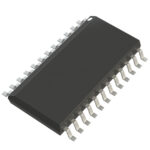 AD7730BR
The activity of extra discounts on wholesale prices is in full swing…
Please fill in your contact information and we will send you the latest wholesale price list.





