 ChipApex | Global Electronic Components Supplier
SEARCH
Search Product
Search Post
— IC芯片 | 连接器 | 传感器 | 被动器件 —
Search productSearch post
— IC芯片 | 连接器 | 传感器 | 被动器件 —
Consult the customer manager about the wholesale price.
consultation hotline:86-132-6715-2157
email:[email protected]
Contact the product manager for consultation. One-stop consultation is available.
Do you want a lower wholesale price? Please send us your inquiry and we will reply immediately.
The AD7740KRM-REEL7 is a low-cost, ultrasmall synchronous Voltage-to-Frequency Converter (VFC) from Analog Devices. It operates from a single 3.0 V to 3.6 V or 4.75 V to 5.25 V supply, consuming typically 0.9 mA in unbuffered mode. The device features an internal 2.5 V bandgap reference and supports a maximum input frequency of 1 MHz. Integral Nonlinearity is specified at ±0.012% of span in unbuffered mode with a 1 MHz clock. The part is housed in an 8-lead MSOP package and is guaranteed for operation from 0 °C to +85 °C.
Verify that the specific ordering suffix matches the required tape and reel packaging configuration. Confirm the temperature grade corresponds to the intended operating environment, as commercial and automotive grades have distinct thermal specifications. Ensure the component is sourced from authorized distributors to guarantee authenticity and traceability. Check for RoHS compliance status if environmental regulations apply to the final assembly.
Select this component for designs requiring a compact, single-channel VFC with minimal external passive components. The choice between buffered and unbuffered modes depends on the source impedance and whether negative input voltages are necessary. Consider the stability of the external clock source, as it directly defines the transfer function accuracy. Evaluate power consumption requirements against the available supply voltage range of 3 V or 5 V.
This component belongs to the AD7740 family of synchronous voltage-to-frequency converters. It is designed to replace asynchronous VFCs that rely on external capacitors for frequency setting, offering superior stability through clock synchronization. The K-grade variant specifically targets commercial temperature ranges, providing a cost-effective solution for space-constrained analog-to-digital conversion tasks.
Direct substitutes within the same package and specification include the AD7740KRMZ and AD7740KRMZ-REEL. Verify pinout compatibility between MSOP variants before substitution.
The full-scale output frequency is set synchronously by the clock signal applied to the CLKIN pin, rather than by external resistors or capacitors.
Yes, in unbuffered mode, the VIN pin can accept signals down to -0.15 V relative to ground.
If the CLKIN pin is held inactive low for approximately 1 ms, the device automatically enters a low-power shutdown mode.
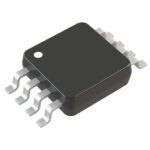 AD7740KRM-REEL7
The activity of extra discounts on wholesale prices is in full swing…
Please fill in your contact information and we will send you the latest wholesale price list.





