 ChipApex | Global Electronic Components Supplier
SEARCH
Search Product
Search Post
— IC芯片 | 连接器 | 传感器 | 被动器件 —
Search productSearch post
— IC芯片 | 连接器 | 传感器 | 被动器件 —
Consult the customer manager about the wholesale price.
consultation hotline:86-132-6715-2157
email:[email protected]
Contact the product manager for consultation. One-stop consultation is available.
Do you want a lower wholesale price? Please send us your inquiry and we will reply immediately.
The AD7740KRMZ-REEL7 is a synchronous Voltage-to-Frequency Converter (VFC) from Analog Devices, housed in an 8-lead MSOP package. It operates on a single supply ranging from 3.0 V to 5.25 V with typical current consumption of 0.9 mA. The device features an internal 2.5 V bandgap reference and supports a maximum input frequency of 1 MHz. Integral Nonlinearity is specified at ±0.012% of span in unbuffered mode and ±0.018% in buffered mode. The K grade version guarantees operation within a temperature range of 0 °C to +85 °C.
Verify that the specific ordering suffix REEL7 corresponds to the tape and reel packaging configuration required for automated assembly processes. Confirm that the K grade designation aligns with the commercial temperature range specifications of 0 °C to +85 °C rather than the automotive Y grade. Ensure compatibility with the 8-lead MSOP footprint during PCB layout verification.
Select this component when space constraints favor an ultrasmall surface-mount package over larger alternatives. Choose the AD7740 for applications requiring low power consumption and simplified circuit design due to the absence of external frequency-setting components. Consider the buffered versus unbuffered input modes based on source impedance requirements and the need for negative voltage input capability.
This device belongs to the AD7740 series of synchronous voltage-to-frequency converters manufactured by Analog Devices Inc. The series emphasizes cost-effectiveness and ease of use through CMOS technology and charge-balance conversion techniques. The product line offers flexibility through different package options and temperature grades to suit various industrial and consumer electronics environments.
AD7740KRMZ
In unbuffered mode (BUF = 0), the analog input VIN can accept signals down to -0.15 V relative to ground, enabling true bipolar operation without the need for a charge pump circuit.
The full-scale output frequency is synchronous with the clock signal on the CLKIN pin. It can be generated by an external crystal connected between CLKIN and CLKOUT or supplied directly by a CMOS-compatible clock source.
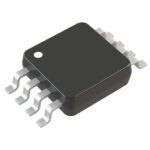 AD7740KRMZ-REEL7
The activity of extra discounts on wholesale prices is in full swing…
Please fill in your contact information and we will send you the latest wholesale price list.





