 ChipApex | Global Electronic Components Supplier
AD7782BRUZ-REEL7
Search Product
Search Post
— IC芯片 | 连接器 | 传感器 | 被动器件 —
Search productSearch post
— IC芯片 | 连接器 | 传感器 | 被动器件 —
Consult the customer manager about the wholesale price.
consultation hotline:86-132-6715-2157
email:[email protected]
Contact the product manager for consultation. One-stop consultation is available.
Do you want a lower wholesale price? Please send us your inquiry and we will reply immediately.
The AD7782BRUZ-REEL7 is a 2-channel, 24-bit sigma-delta analog-to-digital converter (ADC) manufactured by Analog Devices Inc. It operates from a single 3 V or 5 V supply and features a fixed output update rate of 19.79 Hz, providing simultaneous 50 Hz and 60 Hz rejection. The device includes two fully differential analog input channels with pin-selectable ranges of ±160 mV or ±2.56 V via an internal programmable gain amplifier. It utilizes a read-only digital interface compatible with SPI, QSPI, Microwire, and DSP protocols, supporting both master and slave modes without requiring on-chip register programming.
Verify that the ordering suffix matches the required package type and RoHS compliance status. Confirm the specific reel quantity requirements against distributor specifications. Ensure the component version aligns with the latest datasheet revision to guarantee parameter accuracy. Cross-reference the manufacturer part number with authorized distribution channels to validate authenticity and supply chain integrity before finalizing procurement orders.
Select this component when designing low-frequency measurement circuits requiring high resolution without complex digital configuration. The pin-programmable nature simplifies hardware design by removing the need for microcontroller initialization sequences. Consider the fixed 19.79 Hz data rate when determining system throughput requirements. Verify that the external reference voltage source meets the specified common-mode and noise requirements for optimal performance.
This component belongs to the AD778x family of precision analog front ends designed for low-frequency signal acquisition. It shares architectural similarities with other members like the AD7783, which integrates current sources but offers only one differential channel. The AD7782 specifically targets applications needing dual-channel differential input capability with minimal external digital logic overhead.
The AD7782BRU-REEL is a tube-packaged alternative within the same series. The AD7783 serves as a functional variant with integrated current sources and a single differential channel. Verify pin compatibility and channel count requirements when substituting these parts in existing designs.
Configuration is achieved through external logic pins rather than software registers. The CH1/CH2 pin selects between the two differential input pairs, while the RANGE pin sets the full-scale input range to either ±160 mV or ±2.56 V.
The device requires a 32.768 kHz watch crystal connected to the XTAL1 and XTAL2 pins. An internal phase-locked loop generates the necessary operating clock from this frequency.
Yes, the SCLK input in slave mode is Schmitt-triggered, making the interface suitable for opto-isolated applications where noise immunity is critical.
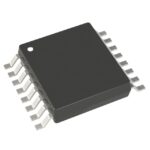 AD7782BRUZ-REEL7
The activity of extra discounts on wholesale prices is in full swing…
Please fill in your contact information and we will send you the latest wholesale price list.