 ChipApex | Global Electronic Components Supplier
AD7783BRU-REEL7
Search Product
Search Post
— IC芯片 | 连接器 | 传感器 | 被动器件 —
Search productSearch post
— IC芯片 | 连接器 | 传感器 | 被动器件 —
Consult the customer manager about the wholesale price.
consultation hotline:86-132-6715-2157
email:[email protected]
Contact the product manager for consultation. One-stop consultation is available.
Do you want a lower wholesale price? Please send us your inquiry and we will reply immediately.
The AD7783BRU-REEL7 is a single-channel, 24-bit sigma-delta analog-to-digital converter (ADC) with pin-configurable input ranges and integrated excitation current sources. It operates from a single 3 V or 5 V supply, consuming 1.3 mA in normal mode and 9 µA in power-down. The device features a fixed update rate of 19.79 Hz, providing simultaneous 50 Hz and 60 Hz rejection. Input ranges are selectable via the RANGE pin: ±160 mV (Gain 16) or ±2.56 V (Gain 1). It includes two 200 mA constant current sources for sensor excitation. The serial interface supports master or slave modes with 3-Wire, SPI, QSPI, Microwire, and DSP compatibility.
Verify component authenticity through authorized Analog Devices distributors or certified partners. Confirm the specific REEL7 tape-and-reel packaging format matches production requirements. Check for RoHS compliance status as indicated in the ordering guide. Ensure storage conditions adhere to ESD sensitivity guidelines to prevent damage to the internal circuitry before installation.
Select this model when a single differential channel with high resolution is required alongside built-in sensor excitation capabilities. Choose the BRU suffix for the standard TSSOP-16 package. Consider the AD7782 if multiple channels are needed but current sources are not required. Verify that the fixed 19.79 Hz update rate aligns with the application's bandwidth constraints and noise filtering needs.
The AD7783 belongs to the AD778x family of precision ADCs designed for low-frequency measurements. It shares architectural similarities with the AD7782 but distinguishes itself by including integrated excitation current sources and supporting a single differential input channel. This positioning makes it suitable for applications requiring simplified front-end designs for resistive bridge sensors.
The AD7782 serves as a related alternative within the same family, offering two differential channels but lacking the integrated excitation current sources found in the AD7783. Designers must account for these functional differences when substituting components, particularly regarding sensor excitation requirements and channel count.
The input range is configured via the RANGE logic pin. Setting RANGE to 0 selects the ±160 mV range with a gain of 16, while setting it to 1 selects the ±2.56 V range with a gain of 1.
The device requires a 32.768 kHz watch crystal connected to the XTAL1 and XTAL2 pins. An internal PLL uses this frequency to generate the necessary operating clock for the ADC.
Yes, in master mode, the AD7783 generates its own SCLK signal. It can drive a simple load or interface directly with systems that do not require complex protocol handling, provided the CS pin is managed appropriately.
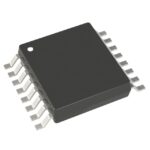 AD7783BRU-REEL7
The activity of extra discounts on wholesale prices is in full swing…
Please fill in your contact information and we will send you the latest wholesale price list.