 ChipApex | Global Electronic Components Supplier
AD7888ARZ-REEL
Search Product
Search Post
— IC芯片 | 连接器 | 传感器 | 被动器件 —
Search productSearch post
— IC芯片 | 连接器 | 传感器 | 被动器件 —
Consult the customer manager about the wholesale price.
consultation hotline:86-132-6715-2157
email:[email protected]
Contact the product manager for consultation. One-stop consultation is available.
Do you want a lower wholesale price? Please send us your inquiry and we will reply immediately.
The AD7888ARZ-REEL is a micropower, 12-bit successive-approximation analog-to-digital converter (ADC) manufactured by Analog Devices Inc. It features eight single-ended analog inputs and operates from a single 2.7 V to 5.25 V power supply. The device supports throughput rates up to 125 kSPS with a full-power bandwidth of 2.5 MHz. It integrates an on-chip 2.5 V reference or accepts external references between 1.2 V and VDD. The ADC utilizes a serial interface compatible with SPI, QSPI, Microwire, and DSP standards. It is housed in a 16-lead TSSOP package.
Verify the specific ordering suffix against official documentation to confirm package type and reel specifications. Ensure compatibility with required operating temperature ranges and voltage levels. Confirm RoHS compliance status through manufacturer datasheets. Validate pin configurations and electrical characteristics against system requirements before procurement.
Select this component for applications requiring an 8-channel input solution in a compact footprint. Consider the trade-off between throughput rate and power dissipation when configuring power management bits. Ensure the analog input source impedance is low enough to maintain specified total harmonic distortion performance. Verify that the serial clock frequency aligns with the desired conversion speed.
The AD7888 belongs to the AD7888 series of micropower ADCs. It is designed to provide space-saving advantages over alternative solutions by housing an 8-channel ADC in a 16-lead TSSOP package. This package size is comparable to an 8-lead SOIC but offers less than half the height, making it suitable for dense PCB layouts.
Publicly confirmed substitute part numbers are not available in the provided documentation. Consult Analog Devices technical support for qualified replacements if this specific package or revision is unavailable.
Channel selection is controlled by the ADD0, ADD1, and ADD2 bits in the Control Register. These bits are loaded via the DIN pin on the rising edge of SCLK and determine which of the eight analog inputs (AIN1–AIN8) is converted next.
This pin provides access to the on-chip 2.5 V reference for external use. Alternatively, it allows an external reference voltage between 1.2 V and VDD to be applied, which automatically overdrives the internal reference.
The device offers four power modes: Normal Operation, Full Shutdown, Autoshutdown, and Autostandby. These are selected via PM1 and PM0 bits in the Control Register, allowing the user to balance throughput rate with power dissipation.
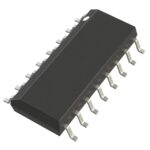 AD7888ARZ-REEL
The activity of extra discounts on wholesale prices is in full swing…
Please fill in your contact information and we will send you the latest wholesale price list.