 ChipApex | Global Electronic Components Supplier
AD7988-1BRMZ-RL7
Search Product
Search Post
— IC芯片 | 连接器 | 传感器 | 被动器件 —
Search productSearch post
— IC芯片 | 连接器 | 传感器 | 被动器件 —
Consult the customer manager about the wholesale price.
consultation hotline:86-132-6715-2157
email:[email protected]
Contact the product manager for consultation. One-stop consultation is available.
Do you want a lower wholesale price? Please send us your inquiry and we will reply immediately.
The AD7988-1BRMZ-RL7 is a 16-bit, low-power PulSAR analog-to-digital converter (ADC) manufactured by Analog Devices Inc. It operates at a throughput of 100 kSPS with a single 2.5 V supply and supports logic interfaces from 1.8 V to 5 V. The device features a pseudo-differential input range of 0 V to VREF, where VREF can be set between 2.4 V and 5.1 V. Key performance metrics include a typical Signal-to-Noise Ratio (SNR) of 91.5 dB, Integral Nonlinearity (INL) of ±1.25 LSB maximum, and Differential Nonlinearity (DNL) of ±0.9 LSB maximum. Total power dissipation is 700 µW at 100 kSPS. It utilizes a versatile serial interface compatible with SPI, Microwire, and DSP protocols, housed in a 10-lead MSOP package.
Verify the specific suffix RL7 indicates reel packaging when sourcing components. Confirm that the BRMZ designation corresponds to the MSOP-10 package variant rather than the LFCSP option. Ensure compatibility with the required operating temperature range of -40°C to +125°C for the intended application environment.
Select this component for applications requiring high resolution with minimal power draw at moderate sampling rates. The pseudo-differential input architecture simplifies front-end design compared to fully differential counterparts. Consider the external reference requirement and ensure the host system provides a stable VREF within the specified 2.4 V to 5.1 V range for optimal accuracy.
This part belongs to the AD7988-1/AD7988-5 family of 16-bit PulSAR ADCs. The AD7988-1 variant specifically targets lower throughput requirements compared to the AD7988-5, which offers 500 kSPS. Both share identical pinouts and architectural features, differing primarily in conversion speed and associated power dissipation characteristics under full load conditions.
The AD7988-5BRMZ serves as a higher-speed alternative within the same package and pinout configuration. For applications requiring fully differential inputs, the AD7680 series may be considered, though it differs in input architecture and supply voltage ranges. Verify pin compatibility before substituting any related devices.
In chain mode, the SDI pin must be held low during the rising edge of CNV. This allows multiple ADCs to be daisy-chained on a single SDO line, with data shifting out sequentially based on the SCK clock cycles following the CNV pulse.
The reference voltage directly influences the signal-to-noise ratio and total harmonic distortion. Higher VREF values generally improve SNR and SINAD, with specifications typically measured at VREF = 5 V for optimal dynamic range performance.
Yes, the device features a separate VIO pin that powers the digital I/O interface. This allows the logic levels to range from 1.8 V to 5 V, independent of the 2.5 V analog supply (VDD), facilitating interfacing with various microcontrollers and DSPs.
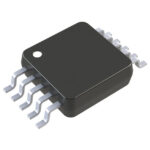 AD7988-1BRMZ-RL7
The activity of extra discounts on wholesale prices is in full swing…
Please fill in your contact information and we will send you the latest wholesale price list.