 ChipApex | Global Electronic Components Supplier
SEARCH
Search Product
Search Post
— IC芯片 | 连接器 | 传感器 | 被动器件 —
Search productSearch post
— IC芯片 | 连接器 | 传感器 | 被动器件 —
Consult the customer manager about the wholesale price.
consultation hotline:86-132-6715-2157
email:[email protected]
Contact the product manager for consultation. One-stop consultation is available.
Do you want a lower wholesale price? Please send us your inquiry and we will reply immediately.
The AD807A-155BRZ is a fiber optic receiver integrating data quantization, signal level detection, clock recovery, and data retiming for 155 Mbps NRZ signals. It meets CCITT G.958 STM-1 Type A and Bellcore OC-3 requirements. The device features a phase-locked loop with a nominal center frequency of 155.52 MHz and an output jitter of 2.0 degrees RMS. It operates on a single +5 V or -5.2 V supply with a maximum power consumption of 170 mW.
Verify the specific suffix against the manufacturer's ordering guide to confirm packaging options. The BRZ designation indicates a lead-free RoHS-compliant tube package. Confirm that the required damping factor capacitor value aligns with the desired jitter transfer peaking and acquisition time specifications before finalizing procurement.
Select this component when a highly integrated solution for 155 Mbps NRZ data is required. Ensure the application can accommodate the single-supply voltage range of +5 V or -5.2 V. Consider the external damping capacitor selection carefully, as it directly influences the loop bandwidth, jitter peaking, and acquisition time performance relative to system timing constraints.
The AD807 belongs to Analog Devices' family of high-speed fiber optic receivers. It is designed to replace discrete solutions by combining the functions of a quantizer, comparator, and phase-locked loop into one 16-lead SOIC package. This integration reduces board space and simplifies the design of SONET/SDH compliant optical links.
The AD807A-155BRRL7 serves as a reel-packaged alternative within the same functional family. Verify pin compatibility and thermal characteristics when substituting between tube and reel formats to ensure mechanical fit within the existing assembly.
No, the device uses a phase-locked loop type clock recovery architecture that does not require an external crystal or SAW filter for frequency acquisition.
Jitter peaking is controlled by selecting the value of an external damping factor capacitor connected between pins CF1 and CF2. Larger capacitance values generally reduce peaking but increase acquisition time.
The SDOUT pin provides a signal detect output that indicates whether the input signal amplitude has fallen below a user-adjustable threshold, signaling a loss of signal condition.
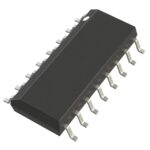 AD807A-155BRZ
The activity of extra discounts on wholesale prices is in full swing…
Please fill in your contact information and we will send you the latest wholesale price list.





