 ChipApex | Global Electronic Components Supplier
SEARCH
Search Product
Search Post
— IC芯片 | 连接器 | 传感器 | 被动器件 —
Search productSearch post
— IC芯片 | 连接器 | 传感器 | 被动器件 —
Consult the customer manager about the wholesale price.
consultation hotline:86-132-6715-2157
email:[email protected]
Contact the product manager for consultation. One-stop consultation is available.
Do you want a lower wholesale price? Please send us your inquiry and we will reply immediately.
The AD8116JSTZ is a high-speed 16 × 16 buffered video crosspoint switch matrix manufactured by Analog Devices Inc. It features a –3 dB signal bandwidth exceeding 200 MHz and channel switch times of 60 ns with 0.1% settling. The device provides excellent video performance, including 60 MHz 0.1 dB gain flatness, 0.01% differential gain error, and 0.01° differential phase error at 5 MHz crosstalk levels of –70 dB. It operates on ±5 V supplies while consuming only 90 mA of idle current. The component is housed in a 128-lead LQFP package (14 mm × 14 mm) and is specified over the commercial temperature range of 0 °C to 70°C.
Verify the specific ordering suffix JSTZ corresponds to the lead-free 128-lead LQFP package variant when sourcing. Confirm that the supply voltage requirements match the ±5 V specification for both analog and digital sections. Ensure ESD precautions are observed during handling due to the sensitivity of the CMOS input structures.
Select this component for applications requiring dense routing of high-speed analog or digital video signals within a single package. Consider the power dissipation limits and thermal management requirements associated with the 128-lead plastic LQFP package. Evaluate the need for daisy-chaining capabilities if larger switching matrices beyond 16 × 16 are required for the system design.
The AD8116 belongs to Analog Devices' family of high-speed video crosspoint switches. It serves as a building block for creating larger nonblocking or blocking crosspoint arrays. The device integrates 256 switch points, offering significant area and power savings compared to using smaller discrete switching elements or lower-density ICs for complex signal routing tasks.
Public confirmed substitute part numbers include AD8116JST and AD8116. These variants share the same functional description as a 200 MHz, 16 x 16 Buffered Video Crosspoint Switch. Verify package compatibility and environmental specifications before substitution.
A 0.1 μF capacitor connected from the RESET pin to ground holds the signal low after power application, ensuring all outputs are disabled initially.
Yes, the DATA OUT pin can be directly connected to the DATA IN pin of a follow-on AD8116 to create larger switch arrays.
The maximum safe junction temperature for the plastic encapsulated device is approximately 150 °C, determined by the glass transition temperature of the plastic.
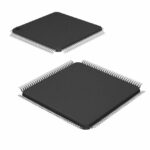 AD8116JSTZ
The activity of extra discounts on wholesale prices is in full swing…
Please fill in your contact information and we will send you the latest wholesale price list.





