 ChipApex | Global Electronic Components Supplier
SEARCH
Search Product
Search Post
— IC芯片 | 连接器 | 传感器 | 被动器件 —
Search productSearch post
— IC芯片 | 连接器 | 传感器 | 被动器件 —
Consult the customer manager about the wholesale price.
consultation hotline:86-132-6715-2157
email:[email protected]
Contact the product manager for consultation. One-stop consultation is available.
Do you want a lower wholesale price? Please send us your inquiry and we will reply immediately.
The AD813AR-14 is a low-power, single-supply triple video amplifier manufactured by Analog Devices Inc. It integrates three current feedback amplifiers in a 14-lead plastic SOIC package. The device operates on supply voltages ranging from +3 V to ±15 V with a maximum quiescent current of 5.5 mA per amplifier. Key electrical specifications include a unity gain bandwidth of 125 MHz and a slew rate of 500 V/μs. It features high-speed disable functions for each channel, output currents up to 50 mA, and differential gain/phase errors optimized for driving 150 Ω back-terminated video loads.
Verify the specific ordering suffix '-14' corresponds to the 14-lead Plastic SOIC (R-14) package variant when sourcing components. Confirm that the industrial temperature range (-40°C to +85°C) aligns with the operational requirements of the target system. Ensure compatibility with standard surface-mount assembly processes for small outline packages.
Select this component for designs requiring multiple video signal paths with strict power constraints. The current feedback architecture necessitates careful selection of feedback resistors to maintain bandwidth stability. Consider the trade-off between feedback resistor magnitude and frequency response peaking when designing for specific gain configurations.
The AD813 series comprises low-cost, single-supply triple video amplifiers designed for broadcast and consumer electronics. The AD813AR-14 specifically denotes the surface-mount version in a 14-lead SOIC package. This family is characterized by its ability to deliver high bandwidth and low distortion while maintaining low static power dissipation compared to traditional voltage feedback alternatives.
The AD813AN serves as the dual in-line package (DIP) equivalent within the same product family. Cross-referencing pinouts and thermal characteristics is required when transitioning between package types.
As a current feedback amplifier, the closed-loop bandwidth depends on the feedback resistor value. Reducing the resistor magnitude increases bandwidth but may introduce peaking, while increasing it reduces peaking at the expense of bandwidth.
Each amplifier has a dedicated high-speed disable function. Activating these pins powers down the respective amplifier or places its output in a high-impedance state, which is useful for video multiplexing applications.
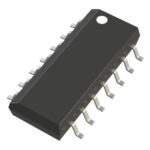 AD813AR-14
The activity of extra discounts on wholesale prices is in full swing…
Please fill in your contact information and we will send you the latest wholesale price list.





