 ChipApex | Global Electronic Components Supplier
SEARCH
Search Product
Search Post
— IC芯片 | 连接器 | 传感器 | 被动器件 —
Search productSearch post
— IC芯片 | 连接器 | 传感器 | 被动器件 —
Consult the customer manager about the wholesale price.
consultation hotline:86-132-6715-2157
email:[email protected]
Contact the product manager for consultation. One-stop consultation is available.
Do you want a lower wholesale price? Please send us your inquiry and we will reply immediately.
The AD8304ARU is a monolithic logarithmic converter designed for fiber optic photodiode interfacing. It provides an exceptionally large dynamic range of 160 dB, covering input currents from 100 pA to 10 mA. The device features a laser-trimmed logarithmic slope of 10 mV/dB at the VLOG pin and a basic intercept at 100 pA. Operating on a single positive supply between 3.0 V and 5.5 V, it draws approximately 4.5 mA of quiescent current. The output buffer offers a bandwidth of 10 MHz and a slew rate of 15 V/µs. It is housed in a miniature 14-lead TSSOP package.
Verify the specific ordering suffix against the manufacturer's official documentation to confirm packaging options such as tube or reel configurations. Ensure the temperature grade matches the application requirements, as the ARU variant is specified for operation from -40°C to +85°C. Cross-reference the part number with the latest datasheet revision to confirm pinout compatibility and absolute maximum ratings before integration into the design.
Select this component when a wide dynamic range logarithmic conversion is required for low-frequency signals. It is particularly suitable for applications involving photodiode interfaces where adaptive biasing helps minimize noise. Consider the available voltage headroom if operating near the minimum supply voltage of 3.0 V, as slope adjustments may be necessary to fit the output swing within the supply rails.
This device belongs to the AD8304 series of logarithmic converters manufactured by Analog Devices. It utilizes a translinear technique to achieve high accuracy and temperature stability across its full operating range. The family is designed to simplify the measurement of signal power in systems requiring precise logarithmic response over multiple decades of input current.
Consult the manufacturer's official cross-reference data for verified substitute part numbers. Do not assume functional equivalence with other logarithmic amplifiers without verifying pinout, supply voltage ranges, and dynamic specifications.
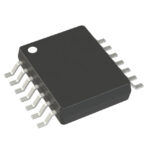 AD8304ARU
The activity of extra discounts on wholesale prices is in full swing…
Please fill in your contact information and we will send you the latest wholesale price list.





