 ChipApex | Global Electronic Components Supplier
SEARCH
Search Product
Search Post
— IC芯片 | 连接器 | 传感器 | 被动器件 —
Search productSearch post
— IC芯片 | 连接器 | 传感器 | 被动器件 —
Consult the customer manager about the wholesale price.
consultation hotline:86-132-6715-2157
email:[email protected]
Contact the product manager for consultation. One-stop consultation is available.
Do you want a lower wholesale price? Please send us your inquiry and we will reply immediately.
The AD8310ARMZ is a demodulating logarithmic amplifier from Analog Devices Inc. It operates from DC to 440 MHz with a 95 dB dynamic range and ±0.4 dB linearity up to 100 MHz. The device features a voltage output with a slope of +24 mV/dB and an intercept of −108 dBV. It requires a single supply voltage between 2.7 V and 5.5 V, drawing a typical quiescent current of 8 mA. The component is housed in an 8-lead MSOP package and supports operation within an industrial temperature range of −40°C to +85°C.
Verify the specific ordering suffix against the manufacturer's official documentation to confirm packaging type and reel specifications. Ensure the component meets RoHS compliance requirements for your assembly process. Cross-reference the datasheet revision history to validate that all electrical parameters match your design constraints before finalizing procurement.
Select this component when a wide dynamic range and fast response time are required for RF signal detection. The fully differential input simplifies matching to standard transmission lines. Consider the external filtering requirements at the OFLT pin if operation at very low audio frequencies or precise offset nulling is necessary for the application.
This part belongs to the AD8310 series of demodulating logarithmic amplifiers. It utilizes a cascade of six amplifier/limiter cells and nine detector cells to achieve its performance characteristics. The device is designed for applications requiring accurate signal level measurement over a broad frequency spectrum without significant external component count.
Consult the manufacturer's official replacement guide for verified substitute part numbers. Do not assume functional equivalence with other logarithmic amplifiers based solely on package compatibility.
The device employs a global feedback path from the last stage to the first to correct accumulated dc offsets. An on-chip filter capacitor suppresses high-frequency feedback, and an external capacitor at the OFLT pin can be added to lower the usable frequency range.
The ENBL pin provides a CMOS-compatible chip enable function. When held low, the device enters a sleep mode with minimal current consumption; when high, it enables full operation with a fast power-up time.
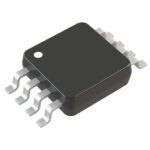 AD8310ARMZ
The activity of extra discounts on wholesale prices is in full swing…
Please fill in your contact information and we will send you the latest wholesale price list.






