 ChipApex | Global Electronic Components Supplier
SEARCH
Search Product
Search Post
— IC芯片 | 连接器 | 传感器 | 被动器件 —
Search productSearch post
— IC芯片 | 连接器 | 传感器 | 被动器件 —
Consult the customer manager about the wholesale price.
consultation hotline:86-132-6715-2157
email:[email protected]
Contact the product manager for consultation. One-stop consultation is available.
Do you want a lower wholesale price? Please send us your inquiry and we will reply immediately.
The AD8328ARQZ is a 5 V upstream cable line driver designed for DOCSIS and EuroDOCSIS reverse path transmission systems. It features digitally programmable gain over a 59 dB range with 1 dB steps via an SPI interface. The device supports differential or single-ended inputs and maintains a 300 Ω output impedance. Key electrical parameters include a bandwidth of 107 MHz, an output noise level of 1.2 nV/√Hz at minimum gain, and distortion performance of −57.5 dBc SFDR at 21 MHz and −54 dBc at 65 MHz.
Verify the specific package type, as the AD8328 is available in both 20-lead LFCSP and QSOP formats. Confirm that the ordering suffix corresponds to the required thermal and mechanical specifications. Ensure compatibility with the intended serial peripheral interface logic levels. Check for any obsolete status notifications from Analog Devices regarding this component.
Select the AD8328 for applications requiring precise digital gain control in upstream cable paths. It is optimized for driving 75 Ω loads through a 2:1 transformer. Consider the power consumption differences between active and sleep modes. Ensure the input signal source can provide the necessary differential or single-ended drive capability within the specified impedance constraints.
This component belongs to the Analog Devices lineup of RF and microwave integrated circuits. It is specifically engineered for the cable television and broadband access market. The device integrates linear amplification with digital control logic on a single chip, simplifying the design of compliant upstream transmission systems.
No public confirmed substitutes are listed in the provided documentation. Verify if newer revisions or alternative packages from the same manufacturer are available for direct pin-compatible replacement.
The gain is controlled via an SPI interface using three digital data lines: CLK, DATEN, and SDATA. An 8-bit serial word determines the desired output gain.
The TXEN pin places the device into between-burst mode. A Logic 0 disables forward transmission and reduces supply current, while a Logic 1 enables it.
Yes, the AD8328 accepts either differential or single-ended input signals. The differential input impedance is approximately 1.6 kΩ, while the single-ended input is 800 Ω.
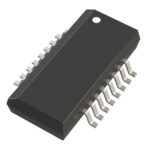 AD8328ARQZ
The activity of extra discounts on wholesale prices is in full swing…
Please fill in your contact information and we will send you the latest wholesale price list.





