 ChipApex | Global Electronic Components Supplier

SEARCH
Search Product
Search Post
— IC芯片 | 连接器 | 传感器 | 被动器件 —
Search productSearch post
— IC芯片 | 连接器 | 传感器 | 被动器件 —
Consult the customer manager about the wholesale price.
consultation hotline:86-132-6715-2157
email:[email protected]
Contact the product manager for consultation. One-stop consultation is available.
Do you want a lower wholesale price? Please send us your inquiry and we will reply immediately.
The AD8402ARU10-REEL is a dual-channel, 8-bit digital potentiometer from Analog Devices Inc., housed in a 14-lead TSSOP surface-mount package. It provides two independent variable resistors with a nominal resistance of 10 kΩ and 256 tap positions. The device operates on a single supply voltage ranging from 2.7 V to 5.5 V and features an SPI-compatible 3-wire serial interface for data loading at rates up to 10 MHz. Key electrical characteristics include a typical wiper resistance of 100 Ω at 5 V, a temperature coefficient of 500 ppm/°C, and a power shutdown current of less than 5 μA.
Verify the ordering suffix 'RU' confirms the TSSOP-14 package variant rather than standard SOIC-14. Confirm the '10' suffix indicates the 10 kΩ resistance value. Check for automotive qualification requirements if deploying in vehicle environments. Ensure ESD precautions are observed during handling due to sensitivity. Validate that the reel packaging format meets assembly line specifications.
Select this component when a dual-channel digital solution is required in a compact TSSOP-14 footprint. Choose over the AD8402AR10 if space-constrained PCB layouts favor thin-profile surface mount packages. Consider the 10 kΩ nominal resistance for applications requiring moderate impedance levels. Verify compatibility with 2.7 V to 5.5 V logic levels for the serial interface.
This part belongs to the AD8400/AD8402/AD8403 family of 1-, 2-, and 4-channel digital potentiometers. The AD8402 specifically integrates two independent variable resistors. The 'ARU' designation identifies the automotive-grade, TSSOP-14 package variant, while '10' specifies the 10 kΩ resistance code. The '-REEL' suffix denotes tape-and-reel packaging for automated insertion.
Direct functional substitutes within the same family include the AD8402AR10 (SOIC-14 package) or AD8402AN10 (PDIP-14 package). For quad-channel needs, the AD8403 series offers four channels. Cross-package replacements require verifying pinout compatibility and thermal dissipation limits.
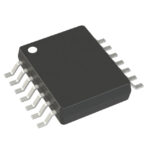 AD8402ARU10-REEL

The activity of extra discounts on wholesale prices is in full swing…
Please fill in your contact information and we will send you the latest wholesale price list.





