 ChipApex | Global Electronic Components Supplier
SEARCH
Search Product
Search Post
— IC芯片 | 连接器 | 传感器 | 被动器件 —
Search productSearch post
— IC芯片 | 连接器 | 传感器 | 被动器件 —
Consult the customer manager about the wholesale price.
consultation hotline:86-132-6715-2157
email:[email protected]
Contact the product manager for consultation. One-stop consultation is available.
Do you want a lower wholesale price? Please send us your inquiry and we will reply immediately.
The AD8495CRMZ is a precision K-type thermocouple amplifier with integrated cold junction compensation, manufactured by Analog Devices Inc. It operates within a supply voltage range of 2.7 V to 36 V and consumes a typical quiescent current of 180 μA. The device provides a linear output transfer function of 5 mV/°C with an initial accuracy of ±1°C at 25°C. It features a 25 kHz bandwidth and settles to 0.1% in 40 μs for a 4 V step. The component is housed in an 8-lead MSOP package and supports an operational temperature range from -40°C to +125°C.
Verify the specific ordering suffix against official documentation to confirm package type and tape-and-reel specifications. Ensure the selected variant matches the required ambient temperature optimization range for the intended application environment.
Select this component when precise K-type thermocouple amplification is required without external calibration. Consider the optimized ambient temperature range of 0°C to 50°C for standard laboratory environments. Verify that the single-supply operation meets the system's power constraints and that the 5 mV/°C output aligns with downstream ADC input ranges.
This part belongs to the AD849x family of precision thermocouple amplifiers. While sharing similar architecture with J-type variants like the AD8494, it is distinctively calibrated for K-type characteristics. The CRMZ suffix indicates a specific commercial-grade packaging configuration within the broader product line.
Direct functional substitutes include the AD8495ARMZ for alternative packaging or the AD8497 if higher ambient temperature operation (25°C to 100°C) is required. Verify pin compatibility and thermal performance before substitution.
The device detects open thermocouples because its PNP input stage bias current flows out of the inputs. Connecting the negative input to ground through a 1 MΩ resistor causes the output to rail high if the thermocouple is disconnected.
Yes, by applying a positive offset voltage to the REF pin, the device can be configured to measure negative temperatures while operating from a single-ended supply.
It is recommended to connect the thermocouple to ground through a 100 kΩ to 1 MΩ resistor placed at the negative input on the PCB to prevent ground loops while allowing proper common-mode rejection.
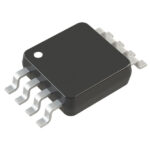 AD8495CRMZ
The activity of extra discounts on wholesale prices is in full swing…
Please fill in your contact information and we will send you the latest wholesale price list.





