 ChipApex | Global Electronic Components Supplier
SEARCH
Search Product
Search Post
— IC芯片 | 连接器 | 传感器 | 被动器件 —
Search productSearch post
— IC芯片 | 连接器 | 传感器 | 被动器件 —
Consult the customer manager about the wholesale price.
consultation hotline:86-132-6715-2157
email:[email protected]
Contact the product manager for consultation. One-stop consultation is available.
Do you want a lower wholesale price? Please send us your inquiry and we will reply immediately.
The AD8497ARMZ-R7 is a precision thermocouple amplifier with integrated cold junction compensation, optimized for K-type thermocouples. It delivers a linear 5 mV/°C output voltage directly proportional to the measurement junction temperature. The device operates on a single supply ranging from 2.7 V to 36 V or dual supplies of ±2.7 V to ±18 V. It features an initial accuracy of ±1.5°C and ambient temperature rejection of 0.025°C/°C within its specified range. The quiescent current is typically 180 μA, and it provides overvoltage protection up to VS ± 25 V.
Verify the specific suffix R7 indicates reel packaging when sourcing. Confirm the ARMZ variant corresponds to the MSOP-8 package. Ensure the component matches the Analog Devices manufacturing origin. Cross-reference the datasheet revision D specifications against the received lot.
Select this model specifically for K-type thermocouple applications requiring operation between 25°C and 100°C ambient temperatures. The AD8497 differs from the AD8495, which is optimized for 0°C to 50°C ambient ranges. Verify that the required measurement junction temperatures fall within the -25°C to +295°C range for ±2°C accuracy.
This component belongs to the AD849x family of precision instrumentation amplifiers designed for direct thermocouple interfacing. The AD8497 variant is distinctively calibrated for K-type sensors with an optimized ambient operating window of 25°C to 100°C. This distinguishes it from the AD8494/AD8496 (J-type) and AD8495 (K-type, 0°C–50°C ambient).
The AD8495 serves as a functional substitute for K-type applications but targets a lower ambient temperature range (0°C to 50°C). Substitution requires verifying that the system's ambient conditions do not exceed the AD8495's optimized range to maintain specified accuracy levels.
The device utilizes PNP input transistors where bias current flows out of the inputs. Connecting the negative input to ground through a 1 MΩ resistor causes the output to rail high if the thermocouple disconnects, enabling break detection.
The REF pin allows offset adjustment of the output voltage. Driving this pin with a low-impedance source enables the measurement of negative temperatures when using a single positive supply.
The inputs provide overvoltage protection (OVP) up to VS ± 25 V, allowing the device to withstand significant voltage excursions without damage.
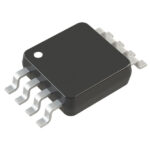 AD8497ARMZ-R7
The activity of extra discounts on wholesale prices is in full swing…
Please fill in your contact information and we will send you the latest wholesale price list.





