 ChipApex | Global Electronic Components Supplier
AD9059BRSZ-REEL
Search Product
Search Post
— IC芯片 | 连接器 | 传感器 | 被动器件 —
Search productSearch post
— IC芯片 | 连接器 | 传感器 | 被动器件 —
Consult the customer manager about the wholesale price.
consultation hotline:86-132-6715-2157
email:[email protected]
Contact the product manager for consultation. One-stop consultation is available.
Do you want a lower wholesale price? Please send us your inquiry and we will reply immediately.
The AD9059BRSZ-REEL is a dual-channel, 8-bit analog-to-digital converter (ADC) manufactured by Analog Devices Inc. It operates at a maximum sampling rate of 60 MSPS with a typical full-power analog bandwidth of 120 MHz. The device integrates an internal 2.5 V voltage reference and dual track-and-hold circuits, requiring only a single 5 V analog supply and a 3 V to 5 V digital supply. It features parallel 8-bit outputs compatible with both 3 V and 5 V logic families. Key electrical specifications include a typical power dissipation of 400 mW, which reduces to less than 12 mW in power-down mode. The component is housed in a 28-lead shrink small outline package (SSOP) and is specified for operation within the industrial temperature range of –40°C to +85°C.
Verify the specific ordering suffix against the manufacturer's current documentation to confirm packaging type and reel specifications. Ensure the procurement source provides valid traceability and authenticity guarantees for Analog Devices components. Confirm that the delivered units match the RS-28 package dimensions and industrial temperature rating defined in the official datasheet.
Select this component when a system requires two synchronized 8-bit ADCs with high analog bandwidth. Consider the AD9057 if only a single channel is needed, as it shares the same core architecture but utilizes a smaller 20-lead package. Evaluate the power supply requirements carefully, noting the separation between the 5 V analog supply and the 3 V to 5 V digital supply options.
The AD9059 belongs to a family of low-cost, low-power monolithic ADCs from Analog Devices. It is designed to replace discrete solutions by integrating references and drivers on a single chip. The device serves as a cost-effective alternative to higher-resolution converters in applications where 8-bit accuracy is sufficient for signal integrity.
The AD9057 is the single-channel equivalent based on the same ADC core. Verify pin compatibility and package differences (20-lead vs. 28-lead SSOP) when substituting. No other direct cross-model replacements are documented in the provided datasheet.
No, the AD9059 cannot be operated in a 2-channel ping-pong mode due to its linked ENCODE architecture, which controls both channels simultaneously.
A 200 ns power-up period should be provided to ensure accurate ADC output data. Valid output data becomes available three clock cycles after this delay.
The internal reference sets the ADC gain and offset. An external reference can overdrive the internal one to adjust gain by up to ±10%, where a 2% change in reference voltage results in a corresponding 2% change in ADC gain and a 50 mV change in offset.
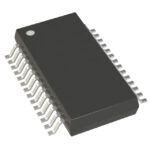 AD9059BRSZ-REEL
The activity of extra discounts on wholesale prices is in full swing…
Please fill in your contact information and we will send you the latest wholesale price list.