 ChipApex | Global Electronic Components Supplier
SEARCH
Search Product
Search Post
— IC芯片 | 连接器 | 传感器 | 被动器件 —
Search productSearch post
— IC芯片 | 连接器 | 传感器 | 被动器件 —
Consult the customer manager about the wholesale price.
consultation hotline:86-132-6715-2157
email:[email protected]
Contact the product manager for consultation. One-stop consultation is available.
Do you want a lower wholesale price? Please send us your inquiry and we will reply immediately.
The AD9822JRSRL is a complete analog signal processor for CCD imaging applications, featuring a 3-channel architecture designed to sample and condition outputs of trilinear color CCD arrays. It integrates an input clamp, correlated double sampler (CDS), offset DAC, and programmable gain amplifier (PGA) multiplexed to a high-performance 14-bit ADC. The device operates from a single 5 V power supply with typical power consumption of 385 mW. It supports 3-channel operation up to 15 MSPS and 1-channel operation up to 12.5 MSPS. The digital output is multiplexed into an 8-bit word accessed via two read cycles, controlled through a 3-wire serial interface.
Verify the specific ordering suffix against the manufacturer's current documentation to confirm package type and temperature range. Ensure compatibility with system voltage requirements, specifically the 5 V analog supply and 3 V/5 V digital I/O levels. Confirm that the serial interface timing constraints meet the microcontroller's capabilities before finalizing procurement.
Select this component for applications requiring integrated signal conditioning for trilinear CCD sensors. Consider the 14-bit resolution and 15 MSPS speed for high-quality image capture. Evaluate the need for CDS functionality versus SHA mode depending on the sensor type. Ensure the PCB layout accommodates the 28-lead SSOP package dimensions and provides adequate decoupling for the analog and digital supplies.
The AD9822 is part of Analog Devices' family of analog signal processors designed for CCD imaging. It serves as a direct replacement for previous generations of discrete signal conditioning circuits, integrating multiple functions into a single chip. The JRSRL suffix indicates a specific variant within the AD9822 product line, typically denoting the package style and reel packaging configuration.
Direct pin-compatible replacements include other variants in the AD9822 series such as the AD9822JR or AD9822JRS, provided the package and electrical specifications match the design requirements. Verify functional equivalence regarding channel count, resolution, and interface compatibility when substituting.
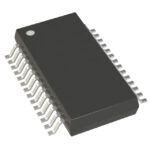 AD9822JRSRL
The activity of extra discounts on wholesale prices is in full swing…
Please fill in your contact information and we will send you the latest wholesale price list.





