 ChipApex | Global Electronic Components Supplier
SEARCH
Search Product
Search Post
— IC芯片 | 连接器 | 传感器 | 被动器件 —
Search productSearch post
— IC芯片 | 连接器 | 传感器 | 被动器件 —
Consult the customer manager about the wholesale price.
consultation hotline:86-132-6715-2157
email:[email protected]
Contact the product manager for consultation. One-stop consultation is available.
Do you want a lower wholesale price? Please send us your inquiry and we will reply immediately.
The ADCS9888CVH-170/NOPB is a high-performance Analog Front End (AFE) designed for digital video applications. It integrates three independent channels, each featuring an 8-bit resolution analog-to-digital converter. The device supports sampling rates up to 170 MSPS and operates with both digital and analog power supplies at 3.3V. Packaged in a 128-MQFP or 128-PQFP format, it delivers low-noise signal processing capabilities suitable for consumer circuit requirements.
Verify the manufacturer designation carefully, as this component was originally developed by National Semiconductor and is now supported under Texas Instruments. Confirm that the specific suffix 'NOPB' indicates lead-free compliance and RoHS adherence. Ensure the package type matches the required 128-pin configuration for your PCB layout. Cross-reference the datasheet version to confirm the 170 MSPS speed grade, as other variants exist.
Select this component when a multi-channel AFE solution is required for video applications. It is appropriate for designs needing integrated 8-bit conversion without external multiplexing. Consider the 128-pin footprint constraints during layout. Evaluate if the 3.3V supply voltage aligns with the system architecture. This part is suitable for applications prioritizing channel integration over higher bit-depth precision.
This component belongs to the ADCS9888 family of video analog front ends. Variants such as the -205 and -140 models offer different sampling rate specifications while maintaining similar architectural features. The series is designed to simplify the design of digital video capture systems by combining multiple functions into a single package. It represents a specialized solution for high-speed video signal conditioning.
Direct substitutes include the ADCS9888CVH-205/NOPB and ADCS9888CVH-140/NOPB. These parts share the same package and pinout but differ in maximum sampling frequency. Verify that the system timing requirements are compatible with the alternative sampling rates before substitution.
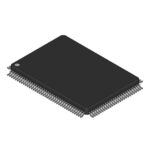 ADCS9888CVH-170/NOPB
The activity of extra discounts on wholesale prices is in full swing…
Please fill in your contact information and we will send you the latest wholesale price list.





