 ChipApex | Global Electronic Components Supplier
SEARCH
Search Product
Search Post
— IC芯片 | 连接器 | 传感器 | 被动器件 —
Search productSearch post
— IC芯片 | 连接器 | 传感器 | 被动器件 —
Consult the customer manager about the wholesale price.
consultation hotline:86-132-6715-2157
email:[email protected]
Contact the product manager for consultation. One-stop consultation is available.
Do you want a lower wholesale price? Please send us your inquiry and we will reply immediately.
The ADIN1100BCPZ is a robust, industrial-grade, low-power single-port 10BASE-T1L Ethernet PHY compliant with IEEE 802.3cg-2019. It supports cable reaches up to 1700 meters using 1.0 V p-p or 2.4 V p-p transmit levels. Power consumption is 39 mW in dual-supply 1.0 V p-p mode and 109 mW in single-supply 2.4 V p-p mode. The device operates from single or dual supplies of 1.8 V or 3.3 V, featuring integrated power supply monitoring, POR, and comprehensive EMC immunity including ±4 kV EFT and ±8 kV air discharge ESD.
Verify the specific suffix BC indicates the extended temperature range (-40°C to +105°C) as defined in the Analog Devices ordering guide. Confirm package type CP corresponds to the 40-lead, 6 mm × 6 mm LFCSP. Ensure design compliance with the required external crystal specifications (25 MHz) or clock input parameters for the selected MAC interface mode.
Select this component for applications demanding low power consumption alongside long cable distances up to 1700 meters. Choose the 1.0 V p-p mode for ultra-low power scenarios (39 mW) and 2.4 V p-p mode for maximum reach. Ensure the host system supports the required MAC interface (MII/RMII/RGMII) and provides appropriate voltage rails (1.8 V/3.3 V) for AVDD and VDDIO domains.
The ADIN1100 belongs to Analog Devices' portfolio of robust, industrial Single Pair Ethernet transceivers designed for 10 Mbps communication. It serves as a key enabler for IIoT and fieldbus replacement architectures, offering a compact solution that integrates PHY analog circuitry, management registers, and MAC logic into a small LFCSP package suitable for space-constrained industrial devices.
Publicly confirmed substitutes include the ADIN1110, which adds MAC functionality, and the ADIN2111, a multi-port switch solution. For direct PHY replacement, verify compatibility with Texas Instruments DP83TD510E or Microchip LAN8670, ensuring differences in MAC interface support and power supply configurations are addressed in the redesign.
The device integrates a Time Domain Reflectometry (TDR) engine that can detect cable faults and measure distance to fault, providing diagnostic information through the MDIO interface.
The ADIN1100 supports both 1.0 V p-p and 2.4 V p-p transmit levels. The 1.0 V p-p level is typically used with a 1.8 V supply for lower power, while 2.4 V p-p requires a 3.3 V supply for extended reach.
Yes, it supports unmanaged configuration via hardware pin strapping, allowing basic link establishment without software intervention, though managed operation via MDIO is recommended for diagnostics.
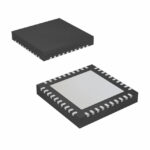 ADIN1100BCPZ
The activity of extra discounts on wholesale prices is in full swing…
Please fill in your contact information and we will send you the latest wholesale price list.





