 ChipApex | Global Electronic Components Supplier
SEARCH
Search Product
Search Post
— IC芯片 | 连接器 | 传感器 | 被动器件 —
Search productSearch post
— IC芯片 | 连接器 | 传感器 | 被动器件 —
Consult the customer manager about the wholesale price.
consultation hotline:86-132-6715-2157
email:[email protected]
Contact the product manager for consultation. One-stop consultation is available.
Do you want a lower wholesale price? Please send us your inquiry and we will reply immediately.
The ADM1485ANZ is a differential line transceiver designed for high-speed bidirectional data communication on multipoint bus transmission lines. It complies with EIA RS-485 and RS-422 standards, featuring one driver and one receiver within an 8-Lead PDIP package. The device operates from a single 5 V power supply with a typical data rate of 30 Mbps. Driver propagation delay is typically 10 ns, while receiver propagation delay is typically 15 ns. The common-mode range spans –7 V to +12 V. Operating temperature ranges from –40°C to +85°C.
Verify the specific ordering suffix against the manufacturer's official documentation to confirm the exact package type and temperature rating. Ensure that the component meets RoHS compliance requirements if applicable to your manufacturing process. Cross-reference the datasheet revision history to confirm that specifications have not changed since the version referenced in your design documents.
Select this component for applications requiring high-speed data rates up to 30 Mbps over multipoint buses. Consider the industrial temperature range and the 8-Lead PDIP package constraints. Evaluate the need for thermal shutdown and fail-safe features relative to the system's noise immunity and fault tolerance requirements.
The ADM1485 series includes variants such as the ADM1485JNZ for commercial temperatures and the ADM1485ARMZ for surface mount applications. The ANZ designation specifically denotes the industrial temperature range variant housed in an 8-Lead Plastic Dual In-Line Package (PDIP). This part serves as a superior upgrade for legacy components like the LTC1485.
The datasheet identifies the ADM1485 as a superior upgrade for the LTC1485. Verify pin compatibility and electrical characteristics before substituting other RS-485 transceivers.
The ADM1485 includes short-circuit protection. If a significant temperature increase is detected due to output shorting, the thermal shutdown circuit forces the driver output into a high impedance state.
The receiver contains a fail-safe feature that results in a logic high output state if the inputs are unconnected or floating.
While up to 32 transceivers may be connected to a bus, only one driver should be enabled at any time to prevent bus contention.
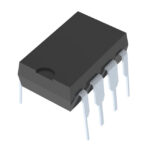 ADM1485ANZ
The activity of extra discounts on wholesale prices is in full swing…
Please fill in your contact information and we will send you the latest wholesale price list.





