 ChipApex | Global Electronic Components Supplier
SEARCH
Search Product
Search Post
— IC芯片 | 连接器 | 传感器 | 被动器件 —
Search productSearch post
— IC芯片 | 连接器 | 传感器 | 被动器件 —
Consult the customer manager about the wholesale price.
consultation hotline:86-132-6715-2157
email:[email protected]
Contact the product manager for consultation. One-stop consultation is available.
Do you want a lower wholesale price? Please send us your inquiry and we will reply immediately.
The ADM202EARNZ-REEL7 is a dual-channel RS-232 line driver and receiver manufactured by Analog Devices Inc. It operates from a single +5 V power supply with a voltage range of 4.5 V to 5.5 V. The device supports data rates up to 230 kbps and features integrated charge-pump circuitry requiring four external 0.1 µF capacitors. It provides ±15 kV ESD protection on all I/O lines, complies with the 89/336/EEC EMC directive, and includes internal 5 kΩ pull-down resistors on receiver inputs. The component is housed in a 16-lead SOIC package.
Verify that the ordering suffix matches the required reel packaging configuration. Confirm the specific temperature grade corresponds to the industrial rating (-40°C to +85°C). Ensure the component version aligns with the Rev. C datasheet specifications regarding hysteresis levels and pin compatibility before finalizing procurement orders.
Select this component when upgrading existing ADM202 or MAX202E designs requiring enhanced EMI performance. It serves as a direct pin-compatible replacement for older generation transceivers while offering improved noise immunity. Consider the TSSOP option if board space constraints are critical, as it reduces footprint compared to standard SOIC packages.
This part belongs to the ADM202E family, which represents an enhancement over the original ADM202 series. It is designed to replace legacy devices like the MAX202E and LT1181A while maintaining electrical compatibility. The 'E' designation indicates extended ESD protection and EMC compliance features not present in earlier iterations.
ADM202EARNZ
Each RS-232 receiver input contains an internal 5 kΩ pull-down resistor to ground. This ensures that unconnected inputs default to a Logic 1 output level.
The ADM202E provides EFT protection up to ±2 kV per IEC1000-4-4 standards, allowing it to withstand electrical fast transient events without permanent damage.
Four external 0.1 µF capacitors are required to support the internal charge-pump voltage doubler and inverter circuits for generating the necessary RS-232 voltage levels.
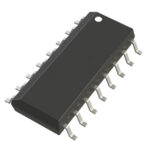 ADM202EARNZ-REEL7
The activity of extra discounts on wholesale prices is in full swing…
Please fill in your contact information and we will send you the latest wholesale price list.





