 ChipApex | Global Electronic Components Supplier
SEARCH
Search Product
Search Post
— IC芯片 | 连接器 | 传感器 | 被动器件 —
Search productSearch post
— IC芯片 | 连接器 | 传感器 | 被动器件 —
Consult the customer manager about the wholesale price.
consultation hotline:86-132-6715-2157
email:[email protected]
Contact the product manager for consultation. One-stop consultation is available.
Do you want a lower wholesale price? Please send us your inquiry and we will reply immediately.
The ADM203JN is a dual-channel RS-232 line driver and receiver pair designed for single 5 V power supply operation. It integrates an on-chip charge pump to generate ±10 V output levels, eliminating the need for external capacitors. The device supports transmission rates up to 120 kBaud and meets EIA-232-E and V.28 specifications. Key electrical parameters include a typical output voltage swing of ±9 V, a maximum VCC power supply current of 6.0 mA, and a propagation delay of 5 µs. The receiver inputs feature overvoltage protection capable of withstanding continuous voltages exceeding ±30 V.
Verify the ordering suffix JN corresponds to the N-20 plastic DIP package and the commercial temperature range of 0°C to 70°C. Confirm that the component matches the specific pinout and internal capacitor integration described in the official Analog Devices datasheet for the ADM203 series.
Select this component when external charge pump capacitors must be avoided to save board space or reduce BOM complexity. It serves as a direct replacement for legacy AD230–AD241 family devices. Ensure the application requires a single 5 V supply and standard RS-232 signaling levels compatible with TTL/CMOS logic interfaces.
The ADM203 is part of the ADM202/ADM203 family of high-speed CMOS RS-232 drivers and receivers. While the ADM202 requires external 0.1 µF capacitors for its charge pump, the ADM203 variant incorporates these components internally. This design simplifies circuit layout while maintaining compatibility with standard RS-232 interface requirements.
The ADM203 is essentially plug-in compatible with the AD230–AD241 family and derivatives thereof.
No, the ADM203 has all charge pump capacitors (C1 to C4) molded into the package, so no external capacitors are required.
The receivers have Schmitt trigger inputs with a hysteresis level of 0.5 V to ensure error-free reception of noisy signals or slow transition times.
Unused transmitter inputs may be left unconnected because an internal 400 kΩ pull-up resistor pulls them high, forcing the outputs into a low state.
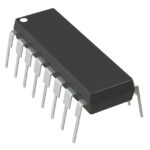 ADM203JN
The activity of extra discounts on wholesale prices is in full swing…
Please fill in your contact information and we will send you the latest wholesale price list.






