 ChipApex | Global Electronic Components Supplier
SEARCH
Search Product
Search Post
— IC芯片 | 连接器 | 传感器 | 被动器件 —
Search productSearch post
— IC芯片 | 连接器 | 传感器 | 被动器件 —
Consult the customer manager about the wholesale price.
consultation hotline:86-132-6715-2157
email:[email protected]
Contact the product manager for consultation. One-stop consultation is available.
Do you want a lower wholesale price? Please send us your inquiry and we will reply immediately.
The ADM2461EBRWZ-RL7 is a half-duplex, signal-isolated RS-485 transceiver manufactured by Analog Devices Inc. It operates at a maximum data rate of 500 kbps and provides 5.7 kV RMS isolation between the primary logic side and the isolated bus side. The device supports a flexible primary supply voltage (VDD1) ranging from 1.7 V to 5.5 V and an isolated secondary supply (VDD2) from 3.0 V to 5.5 V. It features ±15 kV IEC ESD protection on the A, B, Y, and Z pins, high common-mode transient immunity exceeding 250 kV/µs, and cable inversion capabilities for reversed connections. Packaged in a 16-lead wide-body SOIC_W with over 8.0 mm creepage and clearance, it functions across a temperature range of -40°C to +125°C.
Verify component authenticity through authorized distribution channels or direct manufacturer engagement. Confirm that the specific ordering suffix matches the required reel packaging format. Ensure all safety regulatory approvals, including UL 1577 and IEC standards, align with the target application's certification requirements before finalizing procurement.
Select this model for applications requiring galvanic isolation in RS-485 environments with significant ground potential differences. The half-duplex configuration suits bidirectional communication needs. Consider the wide input voltage range for compatibility with various logic levels. Evaluate thermal management requirements given the operating temperature range and package type.
This component belongs to the ADM2461E/ADM2463E family of isolated transceivers. The 'B' indicates the wide-body SOIC package variant, while 'WZ' specifies the tape and reel packaging format. The '-RL7' suffix denotes the specific reel quantity configuration provided by the manufacturer for automated assembly processes.
The ADM2463EBRWZ-RL7 serves as the full-duplex counterpart within the same family. Verify pinout compatibility and duplex mode requirements when substituting. Other series members like the ADM2861E offer similar isolation but may differ in package dimensions or specific electrical characteristics.
The INV pin allows the user to invert the TxD signal and the A/B receiver inputs. This corrects communication errors caused by reversed cable connections on the bus while maintaining full receiver fail-safe performance.
The device exhibits a common-mode transient immunity greater than 250 kV/µs, ensuring reliable operation during rapid voltage changes on the bus lines.
Yes, when operated with a 5 V isolated supply (VDD2), the high differential output voltage meets or exceeds the minimum requirements for Profibus nodes.
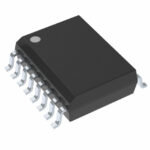 ADM2461EBRWZ-RL7
The activity of extra discounts on wholesale prices is in full swing…
Please fill in your contact information and we will send you the latest wholesale price list.





