 ChipApex | Global Electronic Components Supplier

SEARCH
Search Product
Search Post
— IC芯片 | 连接器 | 传感器 | 被动器件 —
Search productSearch post
— IC芯片 | 连接器 | 传感器 | 被动器件 —
Consult the customer manager about the wholesale price.
consultation hotline:86-132-6715-2157
email:[email protected]
Contact the product manager for consultation. One-stop consultation is available.
Do you want a lower wholesale price? Please send us your inquiry and we will reply immediately.
The ADM3062EARMZ is a half-duplex RS-485 transceiver manufactured by Analog Devices Inc. It operates within a VCC supply range of 3.0 V to 5.5 V and supports a maximum data rate of 500 kbps. The device features an independent VIO logic supply pin, allowing digital interface operation from 1.62 V to 5.5 V. It provides IEC 61000-4-2 electrostatic discharge protection withstanding ±12 kV contact and air discharge on bus pins without latch-up or damage. The component is housed in a 10-lead MSOP package and supports full hot swap capability for glitch-free power-up and power-down sequences.
Verify the specific ordering suffix against official manufacturer documentation to confirm package type and temperature grade. Confirm that the VIO pin is utilized correctly for low-voltage logic interfacing if required by the system design. Ensure proper decoupling capacitors are placed near the VCC and VIO pins as specified in the datasheet guidelines.
Select this model when a half-duplex RS-485 interface is required with robust ESD protection and flexible logic voltage compatibility. The 500 kbps data rate is suitable for long cable runs where slew rate limiting minimizes common-mode emissions. Consider the 10-lead MSOP package for space-constrained designs requiring an exposed pad connection to ground.
The ADM3062EARMZ belongs to the ADM306xE family of RS-485 transceivers designed for harsh industrial environments. This series distinguishes itself through integrated IEC ESD protection and hot swap capabilities. The ADM3062E specifically offers half-duplex communication with a dedicated VIO pin, differentiating it from models like the ADM3061E which lack the separate logic supply.
ADM3062EBRMZ-R7 (Reel version)
Yes, the ADM3062E is fully compliant with the PROFIBUS standard when the VCC supply is greater than or equal to 4.5 V.
The VIO pin provides an independent logic supply ranging from 1.62 V to 5.5 V, allowing the digital interface to operate at voltages lower than the main VCC supply.
Excessive power dissipation caused by bus contention or output shorting is prevented by a thermal shutdown circuit that forces the driver output into a high impedance state upon detecting significant temperature increases.
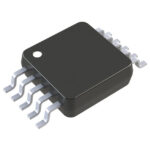 ADM3062EARMZ

The activity of extra discounts on wholesale prices is in full swing…
Please fill in your contact information and we will send you the latest wholesale price list.






