 ChipApex | Global Electronic Components Supplier
SEARCH
Search Product
Search Post
— IC芯片 | 连接器 | 传感器 | 被动器件 —
Search productSearch post
— IC芯片 | 连接器 | 传感器 | 被动器件 —
Consult the customer manager about the wholesale price.
consultation hotline:86-132-6715-2157
email:[email protected]
Contact the product manager for consultation. One-stop consultation is available.
Do you want a lower wholesale price? Please send us your inquiry and we will reply immediately.
The ADM6996LHX-AC-T-1 is a six-port Ethernet switch controller integrating five 10/100 Mbps twisted pair ports and one MII interface port. It supports full/half duplex operation, auto-negotiation, and Auto MDIX. The device features an embedded MAC, PHY, and SRAM memory block for packet buffering and address learning. Key specifications include support for up to 2048 MAC addresses, 802.1Q VLAN tagging with 16 groups, and 802.1p QoS priority handling via four output queues. Power supply requirements are 1.8V and 3.3V, housed in a 128-pin PQFP package.
Verify component authenticity through authorized Infineon distributors or official channels. Confirm RoHS compliance status and check for specific manufacturing date codes relevant to project timelines. Ensure proper ESD handling procedures are followed during assembly due to the CMOS technology used.
Select this component for designs requiring integrated switching capabilities without external PHYs. Consider the 128-pin PQFP package constraints for PCB layout. Verify that the host system can provide the required 1.8V and 3.3V power rails and supports the necessary EEPROM configuration interface.
This part belongs to the ADM6996 family of Ethernet switch controllers developed by Infineon-ADMtek. It serves as a cost-effective solution for network edge devices, combining switching fabric, MAC, and PHY layers into a single silicon die to reduce bill-of-materials complexity.
Publicly confirmed parameter-equivalent substitutes include ADM6996A1T3, ADM6996A2T1, ADM6996FAAT1, ADM6996LAAT1, and ADM6996LX-AA-T-1. Verify pin compatibility and register mapping before substitution.
The ADM6996L supports an address recognition algorithm capable of recognizing up to 2048 different MAC addresses.
Yes, it supports 802.1Q VLAN with Tag/Untag capabilities and implements up to 16 VLAN groups using the last four bits of the VLAN ID.
It supports 802.3x Flow Control pause packets for Full Duplex mode and Back Pressure function for Half Duplex mode to prevent packet loss.
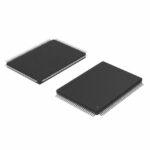 ADM6996LHX-AC-T-1
The activity of extra discounts on wholesale prices is in full swing…
Please fill in your contact information and we will send you the latest wholesale price list.





