 ChipApex | Global Electronic Components Supplier
SEARCH
Search Product
Search Post
— IC芯片 | 连接器 | 传感器 | 被动器件 —
Search productSearch post
— IC芯片 | 连接器 | 传感器 | 被动器件 —
Consult the customer manager about the wholesale price.
consultation hotline:86-132-6715-2157
email:[email protected]
Contact the product manager for consultation. One-stop consultation is available.
Do you want a lower wholesale price? Please send us your inquiry and we will reply immediately.
The ADMV8818SCCZ-EP is a fully monolithic microwave integrated circuit (MMIC) featuring digitally selectable frequency operation across a 2 GHz to 18 GHz range. It integrates four independently controlled high-pass filters (HPFs) and four low-pass filters (LPFs). The flexible architecture allows independent control of the 3 dB cutoff frequencies for both filter types, enabling bandwidths up to 4 GHz. Typical insertion loss is 9 dB, with broadband suppression reaching 35 dB. The component utilizes 4-bit wide digital logic control to adjust on-chip reactance elements, serving as a compact alternative to bulky switch-filter groups.
Verify that the specific suffix SCCZ-EP denotes the extended temperature or military-grade variant when sourcing. Confirm package integrity for the 56-pin LGA form factor during inspection. Ensure compatibility with SPI-based control interfaces using ACE software for proper configuration. Validate supply chain authenticity through authorized distributors to guarantee component traceability and performance consistency in critical applications.
Select this component for applications requiring dynamic frequency agility within the 2 GHz to 18 GHz spectrum. Consider the 9 mm x 9 mm footprint for space-constrained designs replacing larger cavity filters. Evaluate the 35 dB broadband suppression against system harmonic requirements. Ensure control logic supports the required 4-bit digital interface for independent HPF and LPF adjustment to achieve desired bandwidth configurations.
This part belongs to the ADMV8818 family of digitally tunable filters from Analog Devices. It serves as a direct replacement for traditional bulky switch-filter banks and cavity-tuned filters. The EP designation typically indicates an enhanced performance or qualified variant suitable for demanding environments. It complements evaluation boards like the EVAL-ADMV8818 for design verification.
Public confirmed substitute part numbers are not available in the provided documentation. Designers should verify pinout and electrical parameter compatibility if considering alternative MMIC solutions. Check for equivalent digital control interfaces and frequency ranges before substitution.
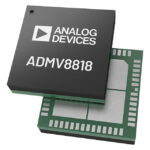 ADMV8818SCCZ-EP
The activity of extra discounts on wholesale prices is in full swing…
Please fill in your contact information and we will send you the latest wholesale price list.





