 ChipApex | Global Electronic Components Supplier
SEARCH
Search Product
Search Post
— IC芯片 | 连接器 | 传感器 | 被动器件 —
Search productSearch post
— IC芯片 | 连接器 | 传感器 | 被动器件 —
Consult the customer manager about the wholesale price.
consultation hotline:86-132-6715-2157
email:[email protected]
Contact the product manager for consultation. One-stop consultation is available.
Do you want a lower wholesale price? Please send us your inquiry and we will reply immediately.
The ADP1870ARMZ-0.3-R7 is a synchronous buck controller from Analog Devices, designed for high-efficiency power conversion. It features a constant on-time architecture with valley current mode control to optimize transient response and efficiency. The device supports switching frequencies of 300 kHz, 600 kHz, and 1 MHz, allowing for flexible inductor selection. It provides a minimum output voltage of 600 mV and can drive loads up to 25 A when paired with appropriate external MOSFETs. Operating within a temperature range of -40°C to +125°C, it ensures reliable performance in demanding environments.
Verify the specific suffix 'R7' indicates reel packaging when sourcing. Confirm the '0.3' designation corresponds to the 600 mV minimum output voltage setting. Ensure compatibility with the 10-MSOP package footprint during PCB layout. Check for moisture sensitivity levels if storage conditions are critical. Validate that the supplier provides original manufacturer documentation to guarantee authenticity.
Choose this component when a synchronous buck topology is required for high-current applications. The constant on-time feature makes it suitable for designs prioritizing fast transient response. Consider the available switching frequency options to minimize passive component size. Ensure the input voltage range aligns with the system's power source. Evaluate thermal dissipation requirements given the LFCSP-10 or MSOP package constraints.
This part belongs to the ADP1870 series of synchronous buck controllers. It is distinct from the ADP1871, which may offer different pin configurations or additional features. The ARMZ suffix denotes a lead-free, halogen-free RoHS-compliant package. The R7 suffix typically indicates tape and reel packaging for automated assembly processes.
Direct substitutes include the ADP1870ACPZ-0.3-R7, which shares identical electrical specifications but utilizes an LFCSP-10 package instead of MSOP. Verify pinout compatibility before swapping packages. Other family members like the ADP1871 may require schematic modifications due to functional differences.
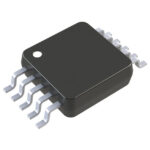 ADP1870ARMZ-0.3-R7
The activity of extra discounts on wholesale prices is in full swing…
Please fill in your contact information and we will send you the latest wholesale price list.





