 ChipApex | Global Electronic Components Supplier
SEARCH
Search Product
Search Post
— IC芯片 | 连接器 | 传感器 | 被动器件 —
Search productSearch post
— IC芯片 | 连接器 | 传感器 | 被动器件 —
Consult the customer manager about the wholesale price.
consultation hotline:86-132-6715-2157
email:[email protected]
Contact the product manager for consultation. One-stop consultation is available.
Do you want a lower wholesale price? Please send us your inquiry and we will reply immediately.
The ADP3808JCPZ-RL is a high-efficiency, synchronous buck controller designed for demanding industrial and automotive applications. It integrates a wide input voltage range of 4.5V to 60V, enabling direct connection to bus voltages without external level shifting. The device features adjustable switching frequencies up to 2MHz, allowing for compact passive component selection. It includes comprehensive protection mechanisms such as over-voltage, under-voltage, and thermal shutdown. The controller supports multiple output configurations through its feedback network and offers precise current mode control for stable operation under varying load conditions.
Verify the specific suffix JCPZ-RL against the manufacturer's official datasheet to confirm package type, temperature grade, and reel quantity. Ensure compatibility with your PCB footprint and thermal management requirements. Cross-reference the ordering part number with authorized distributors to avoid counterfeit components. Confirm that the selected variant meets all regulatory standards required for your specific end-use application.
Select this controller when a wide input voltage range and high efficiency are critical. Consider the thermal performance and available PCB area for inductor placement. Evaluate the need for external MOSFETs based on current requirements. Verify that the switching frequency aligns with EMI constraints and component availability. Ensure the feedback network can achieve the desired output voltage accuracy.
This component belongs to Analog Devices' ADP380x family of synchronous buck controllers. It shares core architectural similarities with other members like the ADP3807 and ADP3809 but differs in specific feature sets and pin configurations. The family is targeted at robust industrial and automotive environments requiring reliable power conversion.
Check for pin-to-pin compatible alternatives within the same product family or from other manufacturers offering similar electrical specifications. Verify that any substitute maintains the required input voltage range and switching frequency capabilities. Ensure thermal and protection features match or exceed the original design requirements.
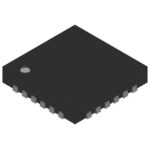 ADP3808JCPZ-RL
The activity of extra discounts on wholesale prices is in full swing…
Please fill in your contact information and we will send you the latest wholesale price list.






