 ChipApex | Global Electronic Components Supplier

SEARCH
Search Product
Search Post
— IC芯片 | 连接器 | 传感器 | 被动器件 —
Search productSearch post
— IC芯片 | 连接器 | 传感器 | 被动器件 —
Consult the customer manager about the wholesale price.
consultation hotline:86-132-6715-2157
email:[email protected]
Contact the product manager for consultation. One-stop consultation is available.
Do you want a lower wholesale price? Please send us your inquiry and we will reply immediately.
The ADPD4100BCBZR7 is a multimodal analog front end from Analog Devices Inc. designed for sensor measurements. It features eight input channels and supports dual-channel processing with simultaneous sampling. The device includes twelve programmable time slots for synchronized measurements and flexible input multiplexing for differential or single-ended configurations. It integrates eight LED drivers capable of driving four simultaneously, with a total peak current of 400 mA. The system offers a flexible sampling rate from 0.004 Hz to 9 kHz using internal oscillators. Key performance metrics include a transmit and receive signal chain SNR of 100 dB and AC ambient light rejection of 60 dB up to 1 kHz. Total system power dissipation is 30 µW during continuous PPG measurement at 75 dB SNR and 25 Hz ODR. It utilizes an SPI interface and contains a 512-byte FIFO.
Verify the specific ordering suffix BCBZR7 against the manufacturer's official documentation to confirm package type and reel specifications. Ensure compatibility with the host system's voltage levels and communication protocols before integration. Cross-reference the component marking with the datasheet outline dimensions to validate authenticity upon receipt.
Select the ADPD4100 variant when SPI communication is required, as opposed to the I2C-based ADPD4101. Evaluate the required LED drive current and input channel count against the eight available channels. Consider the operating temperature range and power consumption constraints relative to the intended application environment and battery life requirements.
This component belongs to the ADPD4100/ADPD4101 family of multimodal sensor front ends. It shares functional similarities with other ADPD series devices but is distinguished by its specific interface and configuration options. The BC designator indicates the commercial temperature grade, while ZR7 denotes the wafer level chip scale packaging and tape-and-reel shipping format.
The ADPD4101BCBZR7 serves as a direct functional substitute if I2C communication is acceptable instead of SPI. Other ADPD series components may require significant schematic and firmware modifications due to differences in pinout, register maps, and interface protocols.
The ADPD4100 supports a total LED peak drive current of 400 mA when multiple LED drivers are used simultaneously.
It provides 60 dB of AC ambient light rejection up to 1 kHz using a synchronous modulation scheme, which eliminates the need for external optical filters or DC cancellation circuitry.
The device includes a 512-byte First-In-First-Out (FIFO) buffer for data storage and retrieval.
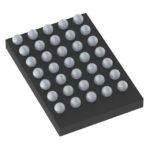 ADPD4100BCBZR7

The activity of extra discounts on wholesale prices is in full swing…
Please fill in your contact information and we will send you the latest wholesale price list.





