 ChipApex | Global Electronic Components Supplier
SEARCH
Search Product
Search Post
— IC芯片 | 连接器 | 传感器 | 被动器件 —
Search productSearch post
— IC芯片 | 连接器 | 传感器 | 被动器件 —
Consult the customer manager about the wholesale price.
consultation hotline:86-132-6715-2157
email:[email protected]
Contact the product manager for consultation. One-stop consultation is available.
Do you want a lower wholesale price? Please send us your inquiry and we will reply immediately.
The ADS1209SPWR is a dual-channel, 16-bit analog-to-digital converter (ADC) from Texas Instruments. It utilizes a second-order delta-sigma modulation architecture to achieve high precision with a sampling rate of 40 kS/s per channel. The device operates on a single 5 V supply for both analog and digital domains, consuming 65.5 mW of power. Key electrical specifications include a signal-to-noise ratio (SNR) of 90 dB, an effective number of bits (ENOB) of 14 bits, and differential nonlinearity (DNL) of +/- 1 LSB. It features an internal oscillator and supports external or internal reference voltages, typically 2.5 V. The component is housed in a TSSOP-24 package and operates within a temperature range of -40°C to +105°C.
Verify the suffix 'PW' corresponds to the TSSOP-24 tube packaging configuration as listed in official datasheets. Confirm RoHS compliance status through the manufacturer's documentation. Ensure the operating environment stays within the specified -40°C to +105°C temperature range. Check for moisture sensitivity level requirements during storage and handling.
Select this component when dual-channel, high-resolution data acquisition is required at moderate speeds. The 16-bit resolution and 90 dB SNR make it suitable for precision applications. Verify that the system can accommodate the 5 V supply voltage. Consider the TSSOP-24 package size for PCB layout constraints. Compare against other ADS120x series variants if different channel counts or pinouts are needed.
The ADS1209SPWR belongs to the ADS1209 family of delta-sigma ADCs. This family is designed for applications requiring multiple channels with high accuracy. The SPWR variant specifically denotes the TSSOP-24 surface-mount package. Other variants in the series may offer different channel counts or package types, such as the ADS1208 or ADS1210.
Direct substitutes within the same family include ADS1208 and ADS1210, provided pin compatibility and channel requirements match. Verify functional equivalence regarding sampling rates and resolution. Cross-reference package dimensions and thermal characteristics for physical fit.
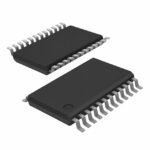 ADS1209SPWR
The activity of extra discounts on wholesale prices is in full swing…
Please fill in your contact information and we will send you the latest wholesale price list.





