ChipApex | Global Electronic Components Supplier
SEARCH
Search Product
Search Post
— IC芯片 | 连接器 | 传感器 | 被动器件 —
Search productSearch post
— IC芯片 | 连接器 | 传感器 | 被动器件 —
Consult the customer manager about the wholesale price.
consultation hotline:86-132-6715-2157
email:[email protected]
Contact the product manager for consultation. One-stop consultation is available.
Do you want a lower wholesale price? Please send us your inquiry and we will reply immediately.
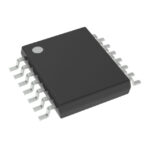
The ADS1222IPWR is a 24-bit delta-sigma analog-to-digital converter (ADC) manufactured by Texas Instruments. It features two differential input channels with an integrated multiplexer and supports data rates up to 240 samples per second using a 4 MHz clock. The device operates on a single supply voltage ranging from 2.7 V to 5.5 V for both analog and digital domains, consuming approximately 300 µA of analog supply current. It utilizes a simple two-wire serial interface compatible with I2C and SPI protocols. Key performance metrics include a maximum integral nonlinearity (INL) of 0.0015% FSR and a differential input range of ±5 V when utilizing the pin-selectable high-impedance input buffer.
Verify the specific suffix 'IPWR' corresponds to the TSSOP-14 package and commercial temperature range (-40°C to +85°C). Confirm RoHS compliance and lead-free status as indicated in official datasheets. Ensure the ordering part number matches the required interface configuration and packaging format before finalizing procurement orders.
Select this component when a 24-bit resolution is required for low-frequency signals with minimal external calibration. Consider the internal reference limitations if higher precision is needed, as the device typically requires an external reference. Evaluate the trade-off between the 240 SPS maximum data rate and system bandwidth requirements compared to faster ADC alternatives.
The ADS1222 belongs to the ADS122x family of low-power, 24-bit delta-sigma ADCs from Texas Instruments. This series is designed for applications demanding high accuracy in small form factors. The IPWR variant specifically denotes the plastic TSSOP surface-mount package, distinguishing it from other package options within the same functional family.
Check for ADS1220 or ADS1221 variants if channel count or data rate differences are acceptable. Verify pin compatibility and register mapping when substituting with other members of the ADS122x family to ensure seamless integration without hardware redesign.
 ADS1222IPWR
The activity of extra discounts on wholesale prices is in full swing…
Please fill in your contact information and we will send you the latest wholesale price list.