 ChipApex | Global Electronic Components Supplier
SEARCH
Search Product
Search Post
— IC芯片 | 连接器 | 传感器 | 被动器件 —
Search productSearch post
— IC芯片 | 连接器 | 传感器 | 被动器件 —
Consult the customer manager about the wholesale price.
consultation hotline:86-132-6715-2157
email:[email protected]
Contact the product manager for consultation. One-stop consultation is available.
Do you want a lower wholesale price? Please send us your inquiry and we will reply immediately.
The ADS127L01IPBSR is a single-channel, 24-bit delta-sigma analog-to-digital converter (ADC) manufactured by Texas Instruments. It supports data rates up to 512 kSPS with a maximum passband of 230 kHz. The device operates on a 2.7 V to 3.6 V analog supply and a 1.7 V to 3.6 V digital supply. Key performance metrics include an SNR of 115.5 dB at OSR 256 and a power consumption as low as 7 mW in specific modes. It features a 32-TQFP package, differential input, SPI interface, and external reference capability.
Verify the specific suffix IPBSR corresponds to the 32-TQFP(5x5) package and Reel/Cut Tape packaging options. Confirm RoHS compliance status and MSL level 2 requirements during storage handling. Ensure the ordering part number matches the exact speed grade and temperature range specifications required for the target application environment.
Select this component when high DC accuracy and AC performance are required in a single-channel configuration. Consider the available operating modes to balance between resolution and power consumption based on system constraints. Verify that the external reference voltage and clock source meet the specified input ranges for optimal SNR performance.
This part belongs to the ADS127L01 series of broadband ADCs from Texas Instruments. It shares architectural similarities with other devices in the family but is distinguished by its single-channel design and specific power-performance trade-offs. The IPBSR designation indicates the surface-mount TQFP package variant suitable for automated assembly processes.
Direct substitutes within the same family include other ADS127L01 variants with different package or speed grades. Cross-referencing requires matching the 24-bit resolution, 512 kSPS max rate, and TQFP-32 footprint. Verify pin compatibility and register settings if replacing with multi-channel versions like the ADS127L02.
Multiple ADS127L01 devices can be synchronized using a common START pin and CLK signal. Deterministic timing is achieved when setup times are met, ensuring DRDY signals transition simultaneously across devices.
Asynchronous DRDY signals may result from transient voltage spikes on the VREFP line exceeding maximum limits or dropping too low, potentially causing internal resets or loss of synchronization.
Yes, the device supports daisy-chain operation via its SPI-compatible serial interface, allowing multiple units to be connected sequentially for efficient data readout.
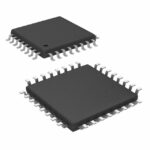 ADS127L01IPBSR
The activity of extra discounts on wholesale prices is in full swing…
Please fill in your contact information and we will send you the latest wholesale price list.




