 ChipApex | Global Electronic Components Supplier
SEARCH
Search Product
Search Post
— IC芯片 | 连接器 | 传感器 | 被动器件 —
Search productSearch post
— IC芯片 | 连接器 | 传感器 | 被动器件 —
Consult the customer manager about the wholesale price.
consultation hotline:86-132-6715-2157
email:[email protected]
Contact the product manager for consultation. One-stop consultation is available.
Do you want a lower wholesale price? Please send us your inquiry and we will reply immediately.
The AEQ05472-T is a surface-mount gain equalizer from Knowles Dielectric Labs designed for signal conditioning applications. It operates across a frequency range of 0 Hz to 18 GHz with a characteristic impedance of 50 ohms. The component provides a positive gain slope of 3.5 dB and features an insertion loss of less than 1 dB. It utilizes SMD/SMT termination and is housed in a 0302 (0605 metric) package. The device supports conductive epoxy and solder mounting methods, ensuring reliable performance within an operating temperature range of -55°C to +125°C.
Verify that the specific part number matches the required gain slope and frequency specifications for your application. Confirm RoHS compliance status through official manufacturer documentation prior to ordering. Ensure that the selected packaging format aligns with your assembly line capabilities. Cross-reference the datasheet for exact electrical tolerances and thermal characteristics to guarantee system reliability under operational conditions.
Select this component when a fixed 3.5 dB positive gain slope is required within the DC to 18 GHz bandwidth. Consider the 0302 package size for space-constrained PCB layouts. Evaluate the low insertion loss specification against system noise budget requirements. Compare with other series members if different gain slopes or alternative mounting methods are preferred for the specific design constraints.
This component belongs to the AEQ series of gain equalizers manufactured by Knowles Dielectric Labs. The series offers various gain slopes ranging from 1 to 3.5 dB, all sharing similar physical footprints for interchangeability. These devices are engineered for high-reliability RF applications, providing stable performance across wide bandwidths while maintaining low insertion loss and consistent impedance matching.
Other parts within the AEQ series may serve as substitutes if different gain slopes are acceptable. Verify mechanical footprint compatibility and electrical parameter alignment before replacement. Consult official substitution lists for confirmed equivalent components.
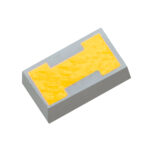 AEQ05472-T
The activity of extra discounts on wholesale prices is in full swing…
Please fill in your contact information and we will send you the latest wholesale price list.





