 ChipApex | Global Electronic Components Supplier
SEARCH
Search Product
Search Post
— IC芯片 | 连接器 | 传感器 | 被动器件 —
Search productSearch post
— IC芯片 | 连接器 | 传感器 | 被动器件 —
Consult the customer manager about the wholesale price.
consultation hotline:86-132-6715-2157
email:[email protected]
Contact the product manager for consultation. One-stop consultation is available.
Do you want a lower wholesale price? Please send us your inquiry and we will reply immediately.
The APTLGL325A1208G is a power driver module from Microchip Technology, classified as an Intelligent Power Module (IPM) utilizing IGBT technology. It features a half-bridge configuration housed in a 6-PowerSIP LP8 package with screw mount installation. The device supports a maximum collector-emitter voltage of 1.2 kV and delivers a continuous collector current of 420 A at 25°C. Key electrical parameters include a collector-emitter saturation voltage of 1.85 V and a power dissipation rating of 1.4 kW. It operates within a temperature range of -40°C to +85°C and includes integrated isolation of 2500Vrms.
Verify the specific part number suffix against official Microchip documentation to ensure correct configuration, as variations may exist within the product family. Confirm that the LP8 package dimensions and pinout match the target PCB layout requirements. Check for any recent Product Change Notifications regarding assembly sites or material composition updates before finalizing procurement specifications.
Select this component when a compact, high-current solution is required for applications demanding 1.2 kV blocking voltage and up to 420 A continuous current. The integrated driver and DC/DC converter reduce external component count compared to discrete solutions. Ensure the thermal management design can handle the specified 1.4 kW power dissipation within the operating temperature range of -40°C to +85°C.
This module belongs to the APTLGT300 series of intelligent power modules from Microchip Technology. It shares the same LP8 package form factor and general interface characteristics as other variants in the family, such as the APTLGT300A1208G, but differs in specific current ratings and saturation voltage parameters defined by its internal die configuration.
The APTLGT300A1208G is a related variant within the same product family sharing the LP8 package. However, it specifies a different continuous collector current of 440 A and a lower saturation voltage of 1.7 V. Direct substitution requires verification that these electrical differences are acceptable for the specific application circuit.
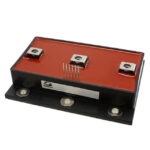 APTLGL325A1208G
The activity of extra discounts on wholesale prices is in full swing…
Please fill in your contact information and we will send you the latest wholesale price list.





