 ChipApex | Global Electronic Components Supplier
SEARCH
Search Product
Search Post
— IC芯片 | 连接器 | 传感器 | 被动器件 —
Search productSearch post
— IC芯片 | 连接器 | 传感器 | 被动器件 —
Consult the customer manager about the wholesale price.
consultation hotline:86-132-6715-2157
email:[email protected]
Contact the product manager for consultation. One-stop consultation is available.
Do you want a lower wholesale price? Please send us your inquiry and we will reply immediately.
The AS8501-ASOT is a high-precision, low-power data acquisition system designed for measuring small signals from shunt resistors and thermocouples. It operates on a single +5V supply and features a 16-bit resolution with differential inputs. The device includes an internal programmable gain amplifier (PGA) with gains of 1, 6, 24, 50, and 100, allowing measurement of input voltage ranges from ±7.5 mV to ±900 mV depending on the gain setting. It supports a maximum sampling frequency of 16 kHz and consumes only 15 mW of power. Key specifications include an offset voltage better than 0.5 µV, an input noise density of 35 nV/√Hz, and an operating temperature range of -40°C to +125°C.
Verify the specific ordering suffix 'ASOT' against the manufacturer's official documentation to confirm package type and tape-and-reel specifications. Ensure compatibility with the SOIC-16 package dimensions and electrical requirements before procurement. Cross-reference the part number with the latest datasheet revision to confirm availability and any potential obsolescence notices.
Select this component when high accuracy and low noise are required for small signal measurements in automotive environments. Consider the PGA gain settings to match the expected input signal range, noting that higher gains offer better resolution for smaller voltages but have narrower input ranges. Evaluate the need for internal temperature sensing and programmable current sources to simplify external circuit design.
The AS8501 is part of a family of specialized sensor interfaces developed by austriamicrosystems, now ams AG. It is designed as a complete front-end data acquisition system, integrating analog and digital functions to reduce external component count. The device is optimized for battery management systems, providing precise monitoring of current, voltage, and temperature parameters essential for reliable operation in automotive applications.
No public confirmed substitute part numbers are available in the provided documentation. Verify pinout and register compatibility if considering alternative devices from other manufacturers. Check for differences in supply voltage requirements and package dimensions to ensure mechanical fit.
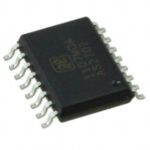 AS8501-ASOT
The activity of extra discounts on wholesale prices is in full swing…
Please fill in your contact information and we will send you the latest wholesale price list.





