 ChipApex | Global Electronic Components Supplier
SEARCH
Search Product
Search Post
— IC芯片 | 连接器 | 传感器 | 被动器件 —
Search productSearch post
— IC芯片 | 连接器 | 传感器 | 被动器件 —
Consult the customer manager about the wholesale price.
consultation hotline:86-132-6715-2157
email:[email protected]
Contact the product manager for consultation. One-stop consultation is available.
Do you want a lower wholesale price? Please send us your inquiry and we will reply immediately.
The AS8501-ASOU is a high-precision sensor interface and data acquisition system designed for low-power applications. It features a 16-bit resolution ADC with differential inputs, operating on a single +5V supply. The device includes a programmable gain amplifier (PGA) with gains of 1, 6, 24, 50, and 100, supporting input ranges from 7mV to 120mV full scale. It offers a maximum sampling frequency of 16 kHz and consumes only 15 mW of power. Key specifications include an internal temperature measurement capability, factory-trimmed precision reference, and extremely low noise density of 35 nV/√Hz. The chip integrates self-calibration, auto-calibration on power-up, and a digital comparator.
Verify the specific suffix 'ASOU' against the manufacturer's official ordering guide to confirm package type and tape-and-reel specifications. Ensure compatibility with the SOIC-16 footprint and check for any updated RoHS compliance documentation. Confirm that the source document matches the revision level required for your design implementation.
Select this component when designing systems requiring high accuracy for small signal measurements from shunt resistors or thermocouples. It is suitable for applications needing simultaneous multi-channel monitoring with minimal external components. Consider the PGA gain settings based on the expected input signal amplitude to optimize dynamic range and noise performance.
The AS8501 is part of the specialized interface IC family originally developed by austriamicrosystems AG, now ams AG. This series focuses on precision analog-to-digital conversion for industrial and automotive sensing. The AS8501 specifically targets battery management and power monitoring where high linearity and low offset are critical requirements.
No direct public substitute part numbers are documented in the provided datasheet. Evaluate alternative high-precision ADCs with similar PGA configurations and 16-bit resolution if sourcing constraints exist. Verify pinout compatibility and register mapping before considering any cross-reference solutions.
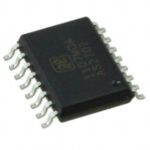 AS8501-ASOU
The activity of extra discounts on wholesale prices is in full swing…
Please fill in your contact information and we will send you the latest wholesale price list.





