 ChipApex | Global Electronic Components Supplier
SEARCH
Search Product
Search Post
— IC芯片 | 连接器 | 传感器 | 被动器件 —
Search productSearch post
— IC芯片 | 连接器 | 传感器 | 被动器件 —
Consult the customer manager about the wholesale price.
consultation hotline:86-132-6715-2157
email:[email protected]
Contact the product manager for consultation. One-stop consultation is available.
Do you want a lower wholesale price? Please send us your inquiry and we will reply immediately.
The ASNT5106-KMC is a broadband tunable signal phase shifter fabricated in SiGe technology, designed for data and clock signals up to 32 Gbps. It features fully differential CML input and output interfaces with internal 50 Ohm termination. The device operates on a single +3.3V or -3.3V power supply, consuming between 1080 mW and 1450 mW depending on the operational speed setting. Key electrical parameters include a phase shift range of 0 to 290 ps, an output jitter of 3.0 ps peak-to-peak, and a tuning port bandwidth of 1000 MHz. The component is housed in a custom 24-pin CQFP package.
Verify the specific ordering suffix KMC corresponds to the 24-pin CQFP package configuration. Confirm that the required voltage supply matches the datasheet specifications of either +3.3V or -3.3V relative to ground. Ensure thermal management solutions are compatible with the center heat slug design for effective dissipation during operation.
Select this component when variable delay adjustment is required for differential CML signals. Consider the adjustable power consumption feature if dynamic speed control is necessary. Verify that the PCB layout supports the specific power supply configuration (positive or negative) as I/O termination requirements differ between modes.
This part belongs to the ADSANTEC ASNT series of high-speed integrated circuits. It utilizes Silicon-Germanium (SiGe) fabrication technology to achieve high performance and reliability. The device is distinct from multiplexers in the same family by its specific function as a variable delay line rather than a data selector.
No public confirmed substitute part numbers are available in the provided documentation. Direct replacement requires matching the SiGe technology node, CML interface compatibility, and the specific 24-pin CQFP package footprint.
Power consumption is adjusted via the single-ended analog control port icrl. Higher voltages at this input correspond to higher power consumption and higher operational speed.
If left not connected, the fbcrl port defaults to an internal level of vcc-0.66V, setting the feedback current to half its maximum value for normal operating mode.
Yes, in AC-coupling mode, the input termination provides the required common mode voltage automatically, whereas DC-coupling requires the input common mode voltage to comply with specific specifications.
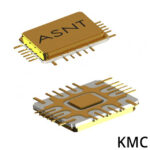 ASNT5106-KMC
The activity of extra discounts on wholesale prices is in full swing…
Please fill in your contact information and we will send you the latest wholesale price list.






